

A Collector’s Guide to Valuable Dollar Bills
How do you identify dollar bills worth money? Valuable and rare one-dollar bills have unusual serial number patterns or genuine printing errors and are often scarce star-note runs or exceptionally well-preserved examples.
A dollar bill is easy to overlook. It lives in your wallet and eventually gets spent without a second thought. However, some dollar bills have survived with characteristics that make collectors stop and look twice.
The challenge is knowing which details matter, which are merely unusual, and which can turn an ordinary $1 bill into a genuinely collectible piece of currency.
If you have valuable $1 bills, getting them appraised is a smart first step. A free online appraisal from Coinfully provides you with a detailed evaluation and a no-obligation offer based on current market conditions. From there, you can decide whether to sell your dollar bills or hold onto them.
Table of Contents
What Dollar Bills Are Worth Money?
Dollar bills worth more than face value usually have a rare serial number, are part of a scarce star-note print run, contain a genuine printing error, are from an older and scarce series or an unusual variety, or are in exceptional condition for their age.
The most valuable examples often combine multiple desirable traits.
Most modern $1 bills are worth only $1, but particularly rare or well-preserved notes can be worth hundreds or even thousands of dollars.
| What To Look For | Identification | Why It’s Valuable | Potential Value |
| Fancy serial numbers | Look for unusually low, high, repeating, mirrored, sequential, or patterned numbers | Distinctive patterns are scarce and collectible | A modest premium to hundreds or more for especially desirable examples |
| Star notes | A star appears at the end of the serial number | Star notes are replacement notes, and some print runs are much scarcer than others | Small premiums for common examples; scarce notes can be worth substantially more |
| Printing errors | Look for missing, doubled, misaligned, or incorrectly printed elements | Genuine production errors can be rare, especially dramatic examples | Major authenticated errors can be worth hundreds or thousands of dollars |
| Older and obsolete note types | Check the series, seal color, note size, and design | Some older notes had lower survival rates or belong to scarce series | Values range from modest collector premiums to thousands of dollars |
| Rare seals or varieties | Compare the seal, district information, signatures, and design details | Certain combinations and varieties were produced in smaller quantities | Depends heavily on the specific variety and condition |
| Exceptional condition | Look for crisp paper, original surfaces, sharp corners, and only minimal signs of circulation | High-grade notes are often far scarcer than circulated examples | Can dramatically increase the value of an otherwise common note |
What Makes a Dollar Bill Valuable?
A dollar bill’s value depends on more than its age. Rarity, serial-number patterns, star notes, genuine printing errors, scarce series or varieties, and condition can all make a $1 bill collectible.
Where To Find Key Information on a Dollar Bill
Start by examining both sides of the bill. The series year appears on the front and identifies the series or design/signature combination. The serial number appears twice on the front.
On $1 Federal Reserve Notes, the first letter identifies the issuing Federal Reserve Bank, while the final letter is a suffix that changes as serial-number ranges are used.
If there is a star symbol at the end of a serial number, this indicates that the bill is a replacement note. The Treasury seal appears on the right, while the Federal Reserve Bank seal appears on the left and identifies the issuing Reserve Bank.
Also note the signatures, overall design and note type, physical size, and condition. These details can help distinguish older note types and varieties and determine whether a seemingly ordinary bill deserves closer examination.
How To Identify Rare 1 Dollar Bills
Finding a potentially valuable $1 bill starts with identifying what makes it unusual and whether that characteristic is actually scarce. Examine the bill systematically for these features:
- Serial number: Look for low, high, repeating, mirrored, sequential, or otherwise unusual patterns.
- Star symbol: Check whether a star replaces the final letter, indicating a replacement note.
- Printing errors: Look for genuine missing, doubled, misaligned, or misplaced elements rather than ordinary wear or damage.
- Series and design: Older or less-common series and note types can have greater collector interest.
- Seals and varieties: Compare seal colors, Federal Reserve identifiers, signatures, and other design details for unusual combinations.
- Condition: Crisp, uncirculated notes with original surfaces and sharp corners can be substantially more desirable than heavily circulated examples.
Rare 1 Dollar Bills: Serial Numbers To Look For
Certain serial-number patterns are especially popular with collectors because they’re visually distinctive and mathematically uncommon. The strongest examples combine an unusual pattern with a scarce note, desirable condition, or another collectible feature.
- Low Serial Numbers: Serial numbers near the beginning of a printing run are especially collectible, with the lowest numbers generally attracting the most interest. Example: 00000001
- High Serial Numbers: Serial numbers containing many consecutive 9s can be desirable, particularly numbers near the highest possible serial number for a given note. Example: 99999999
- Rotator Serial Numbers: Rotator serial numbers appear the same when the note is turned upside down. The usable digits are 0, 1, 6, 8, and 9. Example: 16800891
- Repeater Serial Numbers: A sequence of at least two digits repeats within the serial number. Example: 12341234
- Super Repeater Serial Numbers: A short sequence repeats multiple times across the entire serial number, creating a particularly strong repeating pattern. Example: 12121212
- Radar Serial Numbers: The serial number reads identically from left to right and right to left, making it a palindrome. Example: 12344321
- Ladder Serial Numbers: The digits progress consecutively upward or downward across the serial number. Examples: 12345678 or 87654321
- Solid Serial Numbers: Every digit in the numeric portion is identical, making these among the most visually striking patterns. Example: 77777777
- Binary Serial Numbers: Binary serial numbers use only two digits. True binary serial numbers only contain 0s and 1s. Examples: 55888588 (binary) and 10101010 (true binary)
- Quad Double and Double Quad Serial Numbers: These contain four pairs of repeated digits arranged in a distinctive pattern or two groups of four identical digits. Examples: 11882266 (quad double) or 11112222 (double quad)
- Bookend Serial Numbers: The digits at the beginning and end of the serial number match, creating matching “bookends.” Example: 62500625
Star Notes: Rare One Dollar Bills Worth Money
Star notes are replacement notes printed to replace defective or damaged notes during production and can be identified by a star at the end of the serial number.
A star does not automatically make a $1 bill valuable. Print run, rarity, series, condition, and collector demand determine how valuable a particular star note is.
Dollar Bill Errors That Can Be Worth Money
Genuine printing errors can make $1 bills valuable, particularly when the error is dramatic and escaped the Bureau of Engraving and Printing’s quality controls.
Examples include significant misalignment, mismatched serial numbers, missing printing, inverted or misaligned seals, fold errors, and cutting errors. Minor variations within normal production tolerances, however, do not qualify as collectible errors.
Old Dollar Bills Worth Money
Age alone doesn’t make a $1 bill valuable. Scarce series, obsolete note types, unusual designs or varieties, star notes, distinctive seals or signatures, low surviving populations, and exceptional condition all influence value as well.
Large-size notes and older small-size issues can be particularly collectible, but value depends on the specific issue, rarity, grade, and collector demand.
Old Dollar Bills Value by Type and Series
Old $1 bills encompass several distinct types, and their value can vary dramatically within each category. Series, design, denomination type, rarity, condition, and specific varieties all need to be considered when determining whether an older dollar is worth more than its face value.
| Series and Type | Years Issued | What To Look For | Value Potential |
| Large-size $1 notes | ~1862–1923 | Older designs, different portraits, seal varieties, and scarce series | Often collectible; rare examples can be worth significantly more than face value |
| Small-size Legal Tender $1 notes | 1928–1966 | Red Treasury seal and serial numbers; star notes and high-grade examples | Usually modest premiums, with scarce varieties worth more |
| Silver Certificates | 1928–1953 | Blue Treasury seal and serial numbers; star notes and key series | Common examples may bring small premiums; rare or exceptional notes can be much more valuable |
| Federal Reserve Notes | 1963–present | Star notes, fancy serial numbers, printing errors, and unusual varieties | Most circulated notes are worth face value unless they have a collectible feature |
Modern vs. Older $1 Bill Seals
Modern $1 Federal Reserve Notes have a green Treasury seal, while older $1 notes can have different-colored seals that identify the type of currency. Blue seals indicate Silver Certificates, while red seals identify United States Notes (Legal Tender notes).
How Condition Affects Old Dollar Bill Value
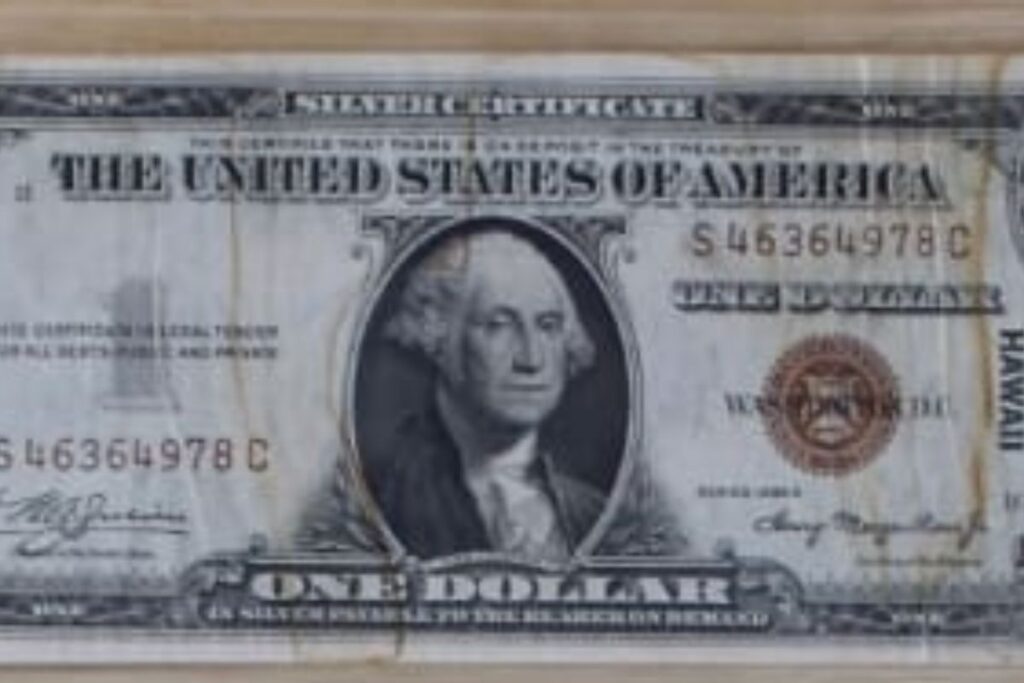
Condition can have a major effect on an old dollar bill’s value, particularly for scarce notes where high-grade examples are difficult to find.
Examine folds, creases, soiling, stains, tears, edge splits, rounded corners, writing, and other signs of circulation, as well as centering and the originality of the paper. Crisp, uncirculated notes with original surfaces generally command the strongest premiums.
Modern Dollar Bills Worth Thousands
In 2014 and 2016, a mistake with orders caused the Bureau of Engraving and Printing facilities in Washington, D.C., and Fort Worth to produce 2013 Series $1 Federal Reserve Notes with duplicate star serial-number ranges from B00000001* to B00250000* and from B03200001* to B09600000*.
A matching pair has exactly the same serial numbers and star designations with one note printed in Washington and the other in Fort Worth, identifiable by the facility initials next to the Treasury seal. PMG-certified examples have sold for thousands of dollars.
What To Do if You Have Valuable 1 Dollar Bills
Once you’ve identified a potentially valuable $1 bill, protect its condition, establish its authenticity and market value, and choose the appropriate level of professional evaluation if you plan on selling it.
Storing Securely
Handle collectible notes as little as possible and with clean, dry hands. Store them flat in an inert, archival-quality currency holder that protects against environmental damage, and keep them away from excessive light, heat, moisture, and fluctuating humidity.
Never tape, staple, fold, laminate, clean, or otherwise alter a potentially valuable note.
Getting an Appraisal
A professional appraisal can help establish a note’s authenticity and correctly identify condition, rarity, and potential market value.
Look for a dealer or numismatic professional experienced with U.S. paper currency, particularly for scarce or unusual notes. Note that the Bureau of Engraving and Printing does not appraise currency.
When To Have a Dollar Bill Graded
Professional grading can be worthwhile when a note is rare, potentially valuable, in exceptional condition, or difficult to authenticate, particularly if you plan to sell it.
Services such as PMG authenticate and grade notes on a 1-to-70 scale, document problems, and encapsulate certified notes in protective holders. Grading is not necessary for low-value circulated $1 bills.
Selling Your Rare $1 Bills
Before selling paper currency, determine the note’s exact type, authenticity, grade or condition, and current market value, and then check recent sales of genuinely comparable examples.
Consider established currency dealers and reputable auctions for significant rarities, and understand the fees or commissions involved before committing to anything.
How Coinfully Can Help With Valuable One Dollar Bills
Coinfully is an online currency buying service headquartered in Charlotte, North Carolina that specializes in appraising and buying rare coins and currency.
If you think you may have dollar bills worth money, Coinfully offers free online appraisals as well as at-home appraisals for qualifying collections.
Coinfully also offers a transparent, streamlined process for selling coins and currency online. If you decide to sell, Coinfully provides fully insured shipping through Lloyd’s of London, and your package will be opened under 4K security cameras, with payment usually issued within 24 hours of verification.
Douglas Winter, who won the American Numismatic Association Numismatist of the Year award in 2024, is the Chief Numismatic Advisor at Coinfully.
According to Douglas Winter, “Coinfully gives a seller an opportunity to get a fair offer that wouldn’t be available to 90-plus percent of prospective sellers.”
Coinfully is an ANA Member Dealer, a PCGS Authorized Dealer, NGC Authorized Dealer, and CAC Authorized Dealer with an A+ BBB rating.
Frequently Asked Questions About Rare Dollar Bills
What makes a dollar bill rare?
Rare dollar bills typically have a scarce series or variety, a desirable serial-number pattern, a genuine printing error, a scarce star-note print run, or exceptional condition. Age alone doesn’t make a $1 bill rare or valuable; rarity and collector demand determine whether it brings a premium.
Are sequential bills worth anything?
Sequential $1 bills usually are not worth more than face value simply because their serial numbers are consecutive. However, sequential notes can be collectible when they also have a desirable fancy serial number, star designation, scarce series, error, or exceptional condition.
What year dollar bills are worth money?
Older $1 bills can be worth more than face value, but the year alone does not determine value. Look at the note type, series, seal color, signatures, serial number, rarity, varieties, and condition. Particularly scarce issues, star notes, errors, and high-grade examples can command substantial premiums.
Do collectible dollar bills rise in value?
Collectible dollar bills can rise or fall in value based on rarity, condition, collector demand, and the prices comparable notes bring in the marketplace. There is no guarantee that a collectible note will appreciate, so past auction results should be treated as historical evidence, not a promise of future value.
What is the most valuable dollar bill to date?
An 1875 $1 Legal Tender Note (Friedberg 21) with a serial number of 1 and an About Uncirculated 50 grade by PMG recently sold through an auction at Stack’s Bowers Galleries for $72,000.

