Silver Dollar Value: How Much Is a Silver Dollar Worth?
Discover Which Silver Dollars Are Worth The Most

Dec 6th, 2025 ·
What is the value of a silver dollar? Silver dollar value is determined by both intrinsic metal content and numismatic factors such as rarity, condition, date, and mintmark. While some coins are worth little more than their silver content, rare or high-grade examples can command premiums far above their bullion value.
Silver dollars have captivated collectors and investors for over two centuries, as they are tangible pieces of history and craftsmanship.
From the first Flowing Hair dollars to modern American Silver Eagles, these coins vary widely in rarity, condition, and design.
Understanding their value requires examining silver content, mint history, and numismatic appeal.
Whether you are curious about bullion worth or seeking guidance on rare issues, this comprehensive guide will help you determine the true value of silver dollars in today’s coin marketplace.
If you are interested in knowing how much your coins are worth or are ready to sell silver dollars in your collection, Coinfully is the easiest, most trusted choice. Contact us today to get your free coin appraisal and top-of-market offer, all with zero pressure to sell.
Table of Contents
The Most Valuable Silver Dollars
Some silver dollars have become iconic for their historical rarity and striking designs.
These coins, often limited by mintage, surviving population, or unique errors, are considered the most valuable silver dollars and frequently attract significant attention from both serious collectors and investors.
Below, you can explore the most valuable silver dollars from each design and their impressive selling prices:
Flowing Hair Silver Dollar (1794–1795)
A 1794 Flowing Hair dollar sold for $12,000,000 in 2013, putting this coin at the top of any list of silver dollars worth money.
This coin’s exceptionally high grade makes it stand out. While other Flowing Hair silver dollars have sold for millions, none have matched the quality of this specific specimen.
Draped Bust Dollar (1795–1803)
Some 1795 Draped Bust dollars with an off-center Lady Liberty have been valued at over $1,000,000, with a 2016 auction sale reaching $1,057,500.
You can identify an off-center Draped Bust silver dollar by checking to see if Lady Liberty’s bust is noticeably to the left, leaving a large blank area on the right. Also, on these off-center strikes, you’ll notice that the ribbons in her hair nearly touch the stars on the left of the coin.
If you collect early U.S. silver dollars, our guide on dollar coins worth money covers some of the rarest and most valuable examples.
1804 Silver Dollar (1834 Until 1869)
1804 silver dollars are incredibly rare coins with few being worth less than a million dollars and the most expensive silver dollar from this year selling for $7,680,000.
The reason that these rare silver dollar coins are so valuable is that they were originally minted 30 years after the actual date stamped on the coin. All of these coins were made with the same head and tail design as the Draped Bust dollar and were meant as diplomatic gifts.
Later 1804 dollar coins were stuck until the die face for the coin was defaced in 1869 to stop the minting of these coins, though some believe that some 1804 dollar coins were struck as late as 1876.
If you are wondering which year of silver dollars are worth the most money, this 1804 dollar would certainly fit the bill. They are worth serious money in nearly all conditions.
Interestingly and not surprisingly, this coin is also one of the most counterfeited U.S. coins.
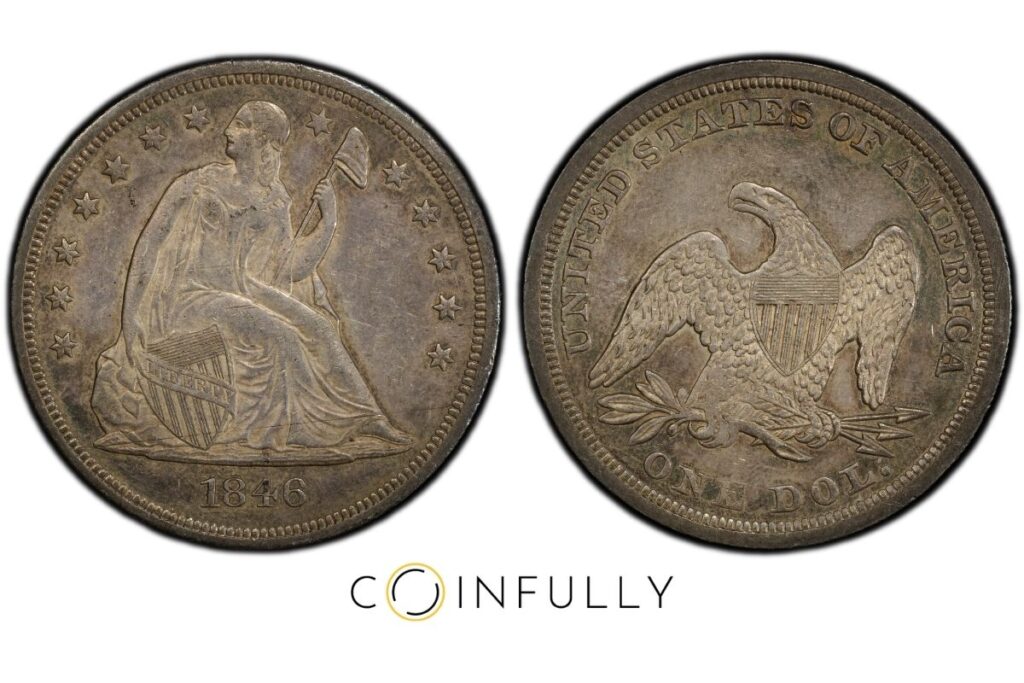
Seated Liberty Dollar (1840–1873)
The record price paid for a Seated Liberty silver dollar was $1,207,500 for an 1866 dollar coin without the motto “In God We Trust” on the coin.
Since the 1866 Seated Liberty dollar coins without mottos were never sold, or given out, by the Mint, it is believed that they were made for high-ranking people associated with the Mint. Only two of these coins are known to exist.
Trade Dollar (1873–1885)
In 2019, a 1885 proof Trade dollar sold for $3,960,000.
1885 proof Trade dollars are some of the rarest and most sought-after coins for collectors since there are only five known to exist. These coins rarely come up for auction or sale. It is believed that the next time one comes up for sale, it will be worth much more than previous records.
Morgan Silver Dollar (1878–1904 & 1921)
The most valuable Morgan dollar is the 1893-S, which sold for $2,086,875 in 2021.
The rarity of this coin stems from its low mintage and the impact of the Pittman Act of 1918, which required millions of silver dollars to be melted down.
If you’re curious about other significant coins in this series, check out our most valuable Morgan dollars guide, and be sure you understand how to sell Morgan dollars for the best price if you’ve been considering selling your collection.
Peace Dollar (1921–1928 & 1934–1935)
There were only 10 1922 Peace silver dollars struck with a high relief. One with a matte finish sold for $458,250 in 2014.
The design of dollar coins were changed to the Peace dollars in 1921 to commemorate the end of World War I.
The 1921 Peace dollars were all planned to be made with a high relief, meaning that the highest point on the coin passes above the edge of the coin.
Due to the pressure needed to make high relief coins, the dies kept shattering, and they were forced to change to low relief coins in 1922. Still, 10 Peace dollars were struck with high relief and are the most valuable of this design.
Eisenhower Dollar (1971–1978)
A 1971 Eisenhower silver dollar minted in San Francisco sold for $30,550.
From 1971 to 1974, Eisenhower dollars contained 40% silver. In 1971, the San Francisco Mint produced 90% silver Eisenhower dollars. While these 90% silver dollar coins were only intended for collectors, some have found their way into circulation and can be quite valuable in good condition.
Are Silver Dollars Worth Money?
Many “silver” dollars that do not contain any silver are worth face value or slightly more.
However, true silver dollars are often worth much more than their face value alone because many contain substantial amounts of silver.
Depending on rarity, demand, and preservation, these coins can be worth far more than their basic metal content. Historical significance and condition also influence how much collectors are willing to pay.
Factors That Impact Silver Dollar Values
Silver dollar values depend on a combination of physical, historical, and market-driven factors. Each factor helps determine whether a silver coin is priced simply for its bullion content or whether it commands a meaningful premium as a more desirable collectible.
Silver Content
The silver content of a coin provides its foundational baseline value. Early Flowing Hair and Draped Bust dollars contained a fineness of .8924 silver, while Seated Liberty, Trade, Morgan, and Peace dollars were struck with 90% silver.
Modern circulating silver dollars contain no silver at all, although a limited number of collector-only Eisenhower dollars were made with a 40% silver and 60% copper composition. Coins with higher purity or total weight of silver typically start at stronger minimum values.
Silver Dollar Melt Value
Melt value reflects the bullion worth of the silver inside the coin. It is calculated by multiplying current market silver prices by the coin’s exact silver weight, which is roughly 0.7734 troy ounces of pure silver for 90% silver dollars.
When collector demand is low, melt value can serve as the realistic minimum price a seller can expect.
Coin Condition and Grade
Condition is one of the strongest drivers of value because wear dramatically affects design detail, luster, and overall eye appeal.
A high-grade or uncirculated dollar in good condition with sharp surfaces and little friction can be many times more valuable than the same date in a lower grade.
Professional grading by a respected third party, such as NGC or PCGS, increases confidence and liquidity in the marketplace and is strongly recommended for particularly valuable coins.
Date and Mintmark
The year and mint facility help determine scarcity. Some issues, including certain 1878 and early 1920s Morgan or Peace dollars, had very high mintages, while others were produced in much smaller quantities.
Mintmarks such as Carson City are particularly notable because many of their coins saw limited distribution or heavy melting, which greatly reduced surviving populations.
Rare Coins and Errors
The most valuable U.S. silver dollars stand out because of unusual minting circumstances, production mistakes, or incredibly small surviving populations.
Dramatic doubled dies, misplaced dates, off-center strikes, and extremely low-mintage issues can all transform a standard example into a major rarity. These pieces attract specialist collectors and often command far higher prices than standard bullion or type-coin issues.
Bullion Value vs. Numismatic Value
Bullion value reflects the intrinsic metal value of a silver dollar based on its fine silver content and current spot price. Numismatic value considers rarity, condition, date, mintmark, and historical significance.
While common silver dollars may be worth only their metal content, collectible issues often command a sale price far above their bullion value.
Types of Silver Dollars
Silver dollars have a long and evolving history in the United States. First produced in 1794 to provide a standardized large denomination coin, designs were regularly updated to reflect artistic trends, economic needs, and minting technology improvements.
Various mints, including Philadelphia, New Orleans, San Francisco, and Carson City, produced these dollars.
Over time, some designs were retired or replaced to improve circulation, appeal to collectors, or commemorate historical events, creating a diverse legacy of different designs and collectible coins.
- Flowing Hair Dollar: 1794–1795
- Draped Bust Dollar: 1795–1804
- Gobrecht Dollar: 1836–1839
- Liberty Seated Dollar: 1840–1873
- Trade Dollar: 1873–1885
- Morgan Dollar: 1878–1921
- Peace Dollar: 1921–1935
- Eisenhower Dollar: 1971–1978
- Commemorative Dollars: 1983–present
- American Silver Eagle: 1986–present
Other Types of Modern Dollar Coins
The coins below typically are only worth face value due to their lack of precious metal content. Nonetheless, many people enjoy collecting the different issues from each year.
- Susan B. Anthony Dollar Coins: 1979–1981, 1999
- Sacagawea Golden Dollar Coins: 2000–2008
- Native American Dollar Coins: 2009–present
- Presidential Dollar Coins: 2007–2011 (general circulation), 2007–2016 (special collector’s editions), and 2020 (one new release)
- American Innovation Dollar Coins: 2018–present
The Value of Modern Silver Dollars
Modern silver dollars differ greatly from historic issues, such as Morgan or Peace silver dollars, in both composition and collector appeal.
Eisenhower dollars, minted from 1971 to 1978, were primarily intended for circulation, though special 40% silver collector editions were produced.
Commemorative silver dollars, issued from 1983 onward, celebrate historical events and figures, generally contain 90% silver, and are typically struck in limited quantities.
American Silver Eagles, first released in 1986, contain a full ounce of silver and are highly popular with collectors. Knowing how to sell Silver Eagle coins strategically can help ensure sellers receive full value.
How To Calculate the Value of a Silver Dollar
Calculating the value of a United States silver dollar requires evaluating both its intrinsic metal and numismatic worth.
Begin by determining the coin’s silver content and multiplying it by the current spot price to find the metal value. Next, consult price guides, auction records, and recent sales to gauge market demand for that date and mintmark.
Numismatic factors such as rarity, condition, and historical significance often raise the coin’s value far above its silver alone.
Professional appraisals provide an expert estimate, while third-party grading assigns an official condition rating, which provides a trusted benchmark for buyers and sellers. These steps should be completed before deciding where to sell your silver coins.
Where To Sell Valuable Silver Dollars
Silver dollars that are worth money can be sold through several channels, but sellers must weigh convenience, security, and potential sale price and know how to sell silver coins safely and effectively to achieve the best price.
- Local coin shops offer convenience but may underpay for rare issues.
- Coin shows and auctions provide exposure to collectors but often involve fees and unpredictable results.
- Online marketplaces expand reach but carry fraud and shipping risks.
- Private investors may offer quick sales, but pricing can be inconsistent.
Coinfully was created to provide a better way to sell coins. With Coinfully, you can get a professional free online appraisal from the comfort of your home. If you decide to sell to us, rest easy knowing that your shipment will be fully insured by Lloyd’s of London.
For qualifying collections, we’ll even come to you to conduct an at-home appraisal and make an offer on the spot. Payment will be issued immediately if you choose to sell. No other coin company offers this level of service and convenience.
Get a Free Coin Appraisal From Coinfully Today
Selling your silver dollars and other valuable coins is simple and stress-free with Coinfully. You can start with a free online appraisal from home or, for qualifying collections, a numismatic expert will travel to you.
We believe in the importance of educating our clients so that they can make informed decisions without ever being pressured to sell.
Contact us today to receive a comprehensive coin appraisal at no cost to you, and even if you decide not to sell, you’ll at least have a firm understanding of what your coins are worth.
Frequently Asked Questions
What silver dollars are worth money?
Most silver dollars are worth at least their face value, but coins with significant silver, rare dates, or high-grade condition often exceed that amount. Value is influenced by silver content, mintage, mintmark, rarity, and demand among collectors.
What silver dollars are valuable?
Silver dollars become valuable when they are rare, in good condition, or feature unique errors. Coins such as Carson City Morgans, early Flowing Hair or Draped Bust dollars, and low-mintage Peace or Morgan issues are particularly prized by collectors.
What is the melt value of a silver dollar?
The melt value is the coin’s worth based solely on its silver content multiplied by the current spot price. For 90% silver dollars, this typically equals about 0.7734 troy ounces of silver, establishing a baseline price even for common coins.
Where is the mintmark on a silver dollar?
Mintmarks identify the facility where a coin was minted and are typically located on the reverse or near the date, depending on the series. For example, Morgan and Peace dollars display the mintmark just below the wreath, while earlier dollars vary by design.
Learn More About Valuable Coins
Wyatt McDonald President & Co-Founder of Coinfully. A student of numismatics and trained in the ANA Seminar in Denver, Wyatt is the face of Coinfully and a true expert. After spending a decade buying coins over the counter at a coin shop, he knew there had to be a better way, for everyone involved.
Get an Appraisal
Think you’re onto something big with your collection? Let’s talk…


 401 Hawthorne Ln, Ste 110-323 - Charlotte, NC 28204