Where To Sell Buffalo Nickels (1913–1938) Without Losing Money
Learn the Best Place To Sell Buffalo Nickels

Dec 8th, 2025 · 5 Minute Read
Where to sell Buffalo nickels? Buffalo nickels can be sold through local coin shops, auctions, private sales, or online marketplaces, but these options often carry inconsistent offers, limited expertise, and security risks. For a safe, transparent, and professionally guided experience that maximizes value, Coinfully is the best choice for selling your collection.
Designed by renowned sculptor James Earle Fraser, the Buffalo nickel marks an important chapter in American coinage history.
If you’re wondering where to sell Buffalo nickels, understanding their historical significance, key dates, and condition is essential before exploring offers.
Although many of these coins are only worth a modest amount, some rare issues are prized by collectors and are worth substantially more. Knowing how to evaluate and protect your collection ensures you receive fair value and a secure transaction.
When you’re ready to sell your Buffalo nickels, start with a professional appraisal from Coinfully. You’ll learn the true value of your collection and receive a top-market offer with no pressure to sell. Contact us today to learn more.
Table of Contents
The Risks You Take With Traditional Selling Venues
When deciding where to sell rare coins such as Buffalo nickels, know that traditional venues, including local coin shops, pawn stores, coin shows, or online platforms, can introduce significant challenges for collectors.
Transporting a valuable coin collection carries security risks that are often underestimated, and sellers frequently encounter inconsistent offers from different buyers that fail to reflect the coin’s true value.
Additionally, many buyers lack the numismatic expertise to accurately evaluate Buffalo nickels, leaving sellers with a grossly undervalued appraisal.
Combined with high overhead costs and a focus on quick resale, traditional methods often mean receiving less than your coins are truly worth.
Coinfully Is the Best Place To Sell Buffalo Nickels
Selling Buffalo nickels should never feel stressful, confusing, or unsafe, yet many traditional routes can make it just that. Coinfully was designed to change the entire selling experience, combining expert numismatic knowledge, personalized service, and full transparency.
While most dealers claim to offer fair value, Coinfully’s online platform and global network of vetted buyers allow for offers that are often significantly higher than those from local shops, auction houses, or coin shows.
Whether you wish to sell just a few rare Buffalo nickels, are selling gold coins, or want to sell silver coins from your collection, Coinfully ensures a smooth, secure, and profitable selling experience.
No-Obligation At-Home Appraisals
Transporting a valuable nickel collection from shop to shop can be intimidating and downright dangerous, and you can imagine the stress of shipping a valuable collection through the mail.
Coinfully eliminates the worry and hassle by providing concierge-level, at-home appraisals for qualifying collections, thus removing the risks of travel or shipping.
A certified numismatist will visit your home or another secure location to carefully examine each coin, discuss its condition and rarity, answer your questions, and deliver a detailed offer on the spot. You will then be free to accept, decline, or take time to consider your options.
Payment either by check or secure electronic transfer is immediate if you move forward, and the complete process remains private, pressure-free, and fully secure.
Free Online Coin Appraisals
For smaller collections or coins that do not qualify for in-person visits, Coinfully offers a free, no-obligation, professional online appraisal service.
Simply submit high-quality photos and key details, and one of our certified experts will evaluate your Buffalo nickels and provide a clear, transparent valuation.
Each appraisal includes an itemized breakdown, showing how factors such as mintmark, coin condition, and rarity influence the offer.
You can then take your time deciding whether or not to sell. If you do choose to sell your coins, your package will be fully insured by Lloyd’s of London and payment will be issued immediately after verification. You’ll enjoy a convenient and secure experience from start to finish.
Where To Sell Buffalo Nickels: Riskier Options
While there are many ways to sell Buffalo nickels, not all options offer security, transparency, or fair pricing. Collectors often encounter inconsistent valuations, limited market reach, and hidden risks when relying on traditional venues, which can significantly reduce your selling price.
Local Coin Shops
Local coin shops may provide a convenient, in-person option, but offers can vary widely between dealers. Many shops lack deep expertise in Buffalo nickels’ numismatic nuances, such as key dates, mintmarks, or condition grades.
Overhead costs may also reduce the payout, and sellers often have no recourse if the shop undervalues their coins.
Online Marketplaces
Selling through online marketplaces exposes sellers to scams, fraudulent buyers, and shipping risks. Photographs rarely convey a coin’s true condition, and wear or high points on key Buffalo nickels may be misjudged by non-expert buyers.
Inconsistent pricing and unverified offers mean sellers could unknowingly accept far less than their coins are worth.
Auction Houses or Online Auctions
Auctions, whether in-person or online, can create competition that benefits sellers but only if lots are marketed correctly. Fees, commissions, and reserve pricing can dramatically reduce net proceeds.
Many Buffalo nickels fail to attract knowledgeable bidders, leaving sellers with coins that may not sell or sell well below their market value.
Coin Shows
Coin shows gather buyers and sellers in a single venue, but offers are often rushed and unverified. Sellers must transport valuable collections, which, of course, exposes them to theft or loss.
With multiple dealers evaluating the same coins, pricing can be unpredictable, and inexperienced sellers may accept suboptimal offers under social pressure.
Private Collectors and Investors
Direct sales to private collectors or investors may seem appealing, but these transactions carry unique risks. Without professional appraisal, buyers can underbid or exploit sellers’ lack of market insight.
Negotiations may be opaque, and there’s limited protection against fraud or nonpayment. Additionally, offers often prioritize collector demand over the coin’s full numismatic value, which further reduces payout.
Buffalo Nickel 1913–1938: History and Importance
The Buffalo nickel, officially minted from 1913 to 1938, was created to replace the long-standing Liberty Head nickels, a design first introduced in 1883.
The U.S. Mint sought a distinctly American design that would celebrate the country’s heritage, moving away from classical European motifs.
Renowned sculptor James Earle Fraser was commissioned in 1911 to design the coin, drawing inspiration from Native American portraits and the American bison.
Fraser created a profile composite of three chiefs for the obverse, thus producing a realistic and respectful representation of Native American culture.
The bison found on the reverse is believed to be modeled after Black Diamond, a bison residing at the New York Central Park Zoo at the time.
Initially, the coin faced production challenges, including rapid wear on high points and difficulty in striking the Type 1 design. The U.S. Mint modified the design by adjusting the bison’s mound to reduce wear and improve circulation, and in 1913, the Type 2 version was introduced.
Over its 25-year run, the Buffalo nickel was minted at three mints (Philadelphia, Denver, and San Francisco) with certain key dates, such as the 1937-D 3-legged buffalo, becoming highly collectible.
By 1938, the design was retired and replaced by the Jefferson nickel, continuing the five-cent denomination but marking the end of the Buffalo nickel’s era.
Many collectors still prize these coins, also known as Indian Head nickels, for their historical significance, their artistry, and the legacy of Fraser’s initial concept.
Design Elements
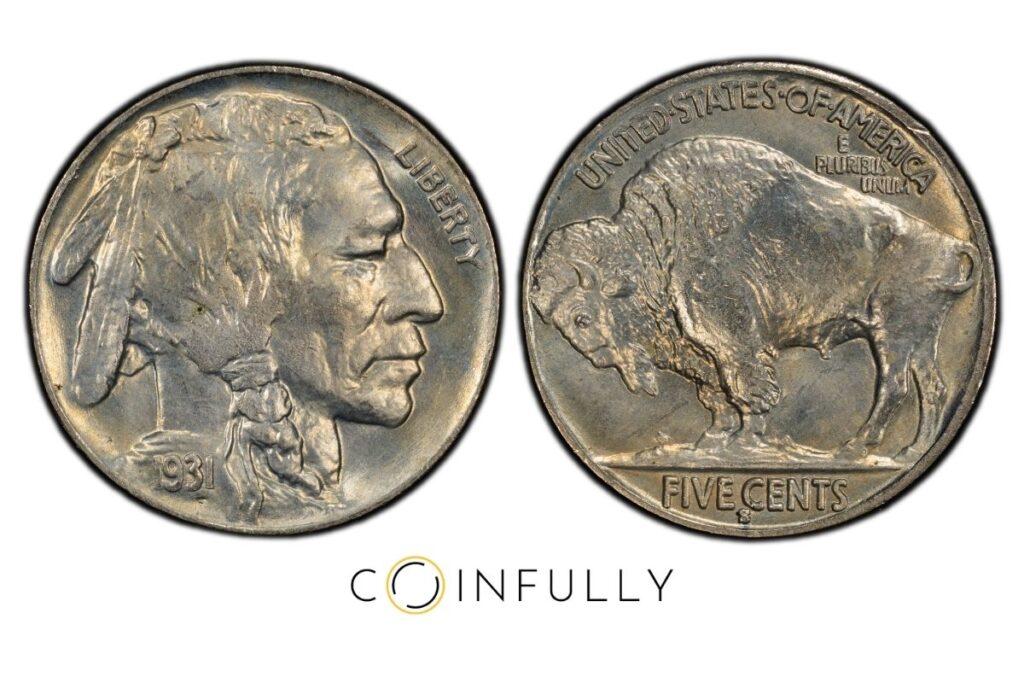
The Buffalo nickel’s obverse features the profile of a Native American chief, which was a composite of three real-life models, with a detailed headdress and facial features reflecting Fraser’s skill.
The word “LIBERTY” appears near the right edge, and the date is placed below the neck.
The American bison on the reverse stands prominently on a raised mound on Type I coins and a flatter mound on Type II coins, symbolizing the frontier and wildlife of the United States.
Text includes “UNITED STATES OF AMERICA,” “E PLURIBUS UNUM,” and the coin’s denomination of five cents, emphasizing its role as standard U.S. coinage.
High points show significant wear in circulated examples, making uncirculated specimens highly sought after by collectors.
What Is the Value of a Buffalo Nickel?
The value of Buffalo nickels varies widely depending on date, mint, condition, and rarity.
Many common dates minted from 1913 to 1938 are worth only a few dollars, particularly if they show wear from circulation. Key dates, such as the 1914-S or 1926-S, can be worth a fortune in uncirculated condition. Proof issues from 1913–1916 also command premium prices.
Numismatists emphasize that proper grading through PCGS or NGC and attention to unique characteristics such as doubled die or die obverse errors, is critical to accurately determining a coin’s collectible value.
What Is the Melt Value of a Buffalo Nickel?
Buffalo nickels are composed of 75% copper and 25% nickel, making the intrinsic metal value extremely low (roughly $0.05). Compared to the numismatic value, Buffalo nickel melt value is insignificant.
Understanding Buffalo Nickel Coin Value
Buffalo nickels’ value is determined by a combination of condition, rarity, and historical significance. Factors such as coin grade, production numbers, unique features, date, and mintmark directly influence a coin’s appeal to collectors and its ultimate market price.
Coin Condition and Grade
The preservation of high points, such as the date, dramatically affects a Buffalo nickel’s value. Coins with minimal circulation, uncirculated examples, or proof coins retain finer details and show less rapid wear, making them far more desirable to collectors.
Mintage Date and Production Numbers
Low-production years such as the 1913-S, 1921-S, 1924-S, and 1926-S often command higher premiums. Matte and brilliant proof issues were produced in low numbers between 1936 and 1937. These can sell for high prices as well.
Coins from mints with smaller runs are rare in uncirculated condition, and limited quantities mean they can be worth exponentially more than common dates.
Mintmark
A Buffalo nickel’s mintmark shows whether it was struck in Philadelphia, Denver, or San Francisco and has a major impact on rarity.
Although each of the three mints produced large volumes, San Francisco often produced the fewest coins, making “S” mintmarks especially valuable in certain years.
Denver issues can also command strong premiums when found in high grade. Because coins from Denver and San Francisco frequently survived with significant wear, well-preserved examples from these mints are much scarcer and therefore far more treasured by collectors.
Key Dates
Some Buffalo nickels, including 1913-S Type II, the 1916 Doubled Die Obverse, the 1918/7-D overdate, the 1921-S, the 1924-S, the 1926-S, and the 1937-D Three-Legged Buffalo, are classified as key dates because few examples survive in high grade.
Collectors prize these coins for scarcity and condition, but even minor wear can dramatically reduce market value.
Minting Errors
Minting errors on Buffalo nickels can add substantial value because they are both scarce and visually distinct. One of the most famous examples is the 1937-D 3-legged variety, created when a mint worker overpolished the die and removed the bison’s front leg.
Other collectible errors include doubled dies, die breaks, cracked planchets, and strike-throughs, each altering design elements in unique ways.
Since these varieties were produced in small numbers and often went unnoticed during circulation, surviving high-grade pieces are rare.
The Importance of a Coin Appraisal To Determine Buffalo Nickel Values
A professional coin appraisal provides an expert, research-based evaluation of your Buffalo nickels, ensuring each coin is accurately identified, authenticated, and valued.
Appraisers assess strike quality, wear patterns, rarity, and market demand, which are factors most sellers can’t reliably determine on their own.
Without an expert appraisal, it’s easy to overlook coins that are significantly more valuable than they appear or to accept offers far below true market value.
Should You Have Buffalo Nickels Graded?
Grading is the formal process of evaluating a coin’s condition using strict, industry-standard criteria. It provides an objective grade, verifies authenticity, and seals the coin in a protective holder with a permanent certification number.
Grading is especially important for high-value, key date coins, as it increases buyer confidence and can dramatically enhance a coin’s marketability and selling price.
Preparing To Sell Your Buffalo Nickels: Steps To Take
Preparing properly before you sell your Buffalo nickels ensures you understand exactly what you have and prevents undervaluing rare or high-grade pieces.
Evaluate Your Collection
Begin by reviewing each coin’s date, mintmark, condition, and any standout characteristics. Separate average pieces from potentially valuable ones.
Get Valuable Coins Appraised
If certain coins appear rare, high-grade, or unusual, have them professionally appraised before selling. An expert can confirm authenticity, evaluate condition, and identify market-sensitive details you might miss.
Gather Documentation and Storage Materials
If you have previous appraisals, purchase receipts, or provenance details, keep them with your collection. Use inert holders, flips, or capsules to protect the coins while preparing them for appraisal or sale.
Gather Multiple Offers and Compare Them Carefully
Request offers from several reputable buyers to understand the range of potential payouts. Compare each offer, focusing on transparency, expertise, hidden fees, and how they justify their evaluation.
Be Certain the Transaction Plan Is Secure
Before agreeing to a sale, ensure the payment method, shipping process, and communication plan are safe and verifiable. Avoid rushed decisions, unclear terms, or unverified buyers.
What Not To Do When Selling Buffalo Nickels
When selling Buffalo nickels, missteps can significantly reduce your collection’s value or create unnecessary risk.
Avoid Unreasonably High Expectations
While some Buffalo nickels are valuable, most dates are modestly priced. Expecting extreme returns from common coins can lead to disappointment or poorly informed decisions.
Do Not Clean Your Coins
Cleaning or polishing Buffalo nickels can permanently damage surfaces and reduce collectible value. Even gentle attempts to improve appearance often remove natural patina or detail, which collectors prize.
Don’t Sell to Pawn Shops
Pawn shops generally prioritize quick resale rather than accurate coin evaluation. Their offers may significantly undervalue rare Buffalo nickels.
Do Not Underestimate the Importance of Appraisals and Grading
Skipping professional appraisals or third-party grading can leave valuable coins unidentified or undervalued. Grading authenticates condition and helps buyers trust the quality of your collection.
Consult with a numismatist to confirm if grading will help the coins value or result in unnecessary grading fees.
Avoid Transactions With Common Red Flags
Be cautious of buyers pressuring you to sell immediately, requesting unusual payment methods, or lacking transparent evaluation criteria. Offers that seem too good to be true often are, and rushing a sale increases the risk of fraud or misrepresentation.
Get the Full Value for Buffalo Nickels With Coinfully
Selling Buffalo nickels requires careful preparation, an understanding of rarity and condition, and awareness of potential risks with traditional selling venues.
Coinfully simplifies the process of selling coins with expert online or at-home appraisals and fast, secure transactions.
Thanks to our access to a global network of buyers, we’re able to make consistently higher offers, and you won’t find a more streamlined, stress-free experience anywhere else.
Whether you have one rare date coin or large collection of valuable coins, Coinfully ensures each coin is evaluated accurately, helping you achieve the full value your Buffalo nickels deserve.
Contact Coinfully today to learn how much your coins are really worth and receive a top-of-market offer.
Learn More About Selling Valuable Coins
Wyatt McDonald President & Co-Founder of Coinfully. A student of numismatics and trained in the ANA Seminar in Denver, Wyatt is the face of Coinfully and a true expert. After spending a decade buying coins over the counter at a coin shop, he knew there had to be a better way, for everyone involved.
Get an Appraisal
Think you’re onto something big with your collection? Let’s talk…


 401 Hawthorne Ln, Ste 110-323 - Charlotte, NC 28204