

Learn Which Valuable Mercury Dimes To Watch For
The 10 most valuable Mercury dimes are:
- 1916-D: $1,700–$52,500+
- 1942/1: $430–$52,000+
- 1942/1-D: $325–$27,500+
- 1921-D: $90–$6,000+
- 1921: $60–$5,750+
- 1926-S: $13–$8,000+
- 1919-D: $5.50–$20,000+
- 1918-D: $4.25–$15,500+
- 1919-S: $6–$15,000+
- 1923-S: $3.75–$5,250+
Mercury dimes, officially called Winged Liberty Head dimes, were struck from 1916 to 1945 and contain 90% silver.
Most are worth a few dollars, but a handful of dates and varieties reach four and five figures, and a few common dates become valuable only when the central horizontal bands on the reverse are fully struck.
If you have a rare Mercury dime in your collection, getting a professional evaluation is the most reliable way to determine value. Coinfully offers free online coin appraisals and, for qualifying large or historically important collections, in-person appraisals conducted at your home.
Table of Contents
Top 10 Most Valuable Mercury Dimes
The Mercury dime series concentrates its value in two groups:
- A small number of genuinely scarce dates and varieties.
- Common dates that are exceptionally difficult to find fully struck.
The table below covers both, tracking each issue from Good through MS65 with Full Bands, a span that carries the 1918-D from $4.25 to $15,500.
*The following list weighs scarcity across all grades rather than single-specimen records.
**The prices below were sourced from NGC and are current as of early August 2026 but are subject to change. The prices reflect dealer retail value, not the buy price you’re offered when selling.
| Year/Mint | Type | Mintage | G | XF | AU55 | MS63 | MS65 | MS65 FB |
| 1916-D | Daterarity | 264,000 | $1,700 | $7,500 | $10,750 | $18,000 | $30,000 | $52,500 |
| 1942/1 | Variety | Unknown | $430 | $650 | $1,100 | $5,500 | $13,000 | $52,000 |
| 1942/1-D | Variety | Unknown | $325 | $625 | $1,450 | $4,500 | $12,000 | $27,500 |
| 1921-D | Daterarity | 1,080,000 | $90 | $725 | $1,300 | $2,475 | $3,200 | $6,000 |
| 1921 | Daterarity | 1,230,000 | $60 | $595 | $1,250 | $2,100 | $3,000 | $5,750 |
| 1926-S | Daterarity | 1,520,000 | $13 | $260 | $675 | $2,350 | $3,850 | $8,000 |
| 1919-D | Conditionrarity | 9,939,000 | $5.50 | $55 | $120 | $580 | $1,750 | $20,000 |
| 1918-D | Conditionrarity | 22,674,800 | $4.25 | $34 | $85 | $275 | $775 | $15,500 |
| 1919-S | Conditionrarity | 8,850,000 | $6 | $55 | $135 | $645 | $1,400 | $15,000 |
| 1923-S | Conditionrarity | 6,440,000 | $3.75 | $75 | $155 | $410 | $1,400 | $5,250 |
Rare Mercury Dimes
Several issues outside the top 10 are scarce, either because mintages were low or because fully struck examples barely exist.
- 1931-D: Only 1,260,000 were struck, which is the fourth-lowest mintage in the series.
- 1945: Philadelphia struck over 159 million, but Full Bands examples are scarce enough to reach $12,750.
- 1938-S and 1931-S: These are ordinary in circulated grades, but both have brought six figures as top-population Full Bands specimens.
Varieties
- 1945-S Micro S: This has a noticeably smaller mintmark punch used only that year.
- 1928-S Large S: It’s estimated that fewer than 5% of 1928-S dimes carry the Large S.
1916-D: The Rarest Mercury Dime
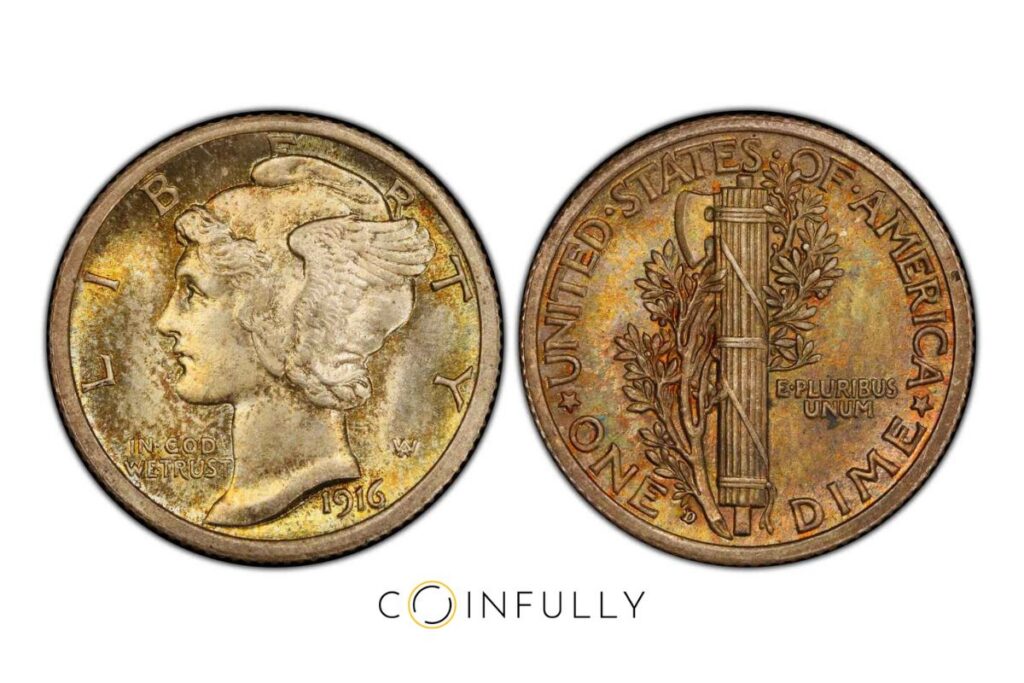
Denver struck only 264,000 dimes in 1916, which is less than a quarter of the next-lowest mintage in the series. Few were saved before the design’s rarity was recognized, so surviving examples skew heavily toward worn grades.
This date is also the most counterfeited in the series, usually done by adding a D mintmark to a 1916 Philadelphia coin, which makes third-party certification essential.
Other Mercury Dimes Worth Money
Beyond the key rare Mercury dime dates, a number of issues carry premiums well above silver in higher grades.
- 1924-S: $14,000 in MS65 FB
- 1927-S: $9,000 in MS65 FB
- 1918-S: $8,000 in MS65 FB
- 1927-D: $6,800 in MS65 FB
- 1920-S: $4,350 in MS65 FB
- 1917-D: $4,250 in MS65 FB
- 1925-D: $3,750 in MS65 FB
- 1925-S: $3,650 in MS65 FB
- 1920-D: $3,250 in MS65 FB
- 1928-D: $2,750 in MS65 FB
Mercury Dimes Value Chart by Year
The chart below covers every date and mintmark in the series from 1916 through 1945. The gap between the MS65 and MS65 FB columns shows how much strike quality alone can be worth on a given issue.
*The prices below were sourced from NGC and are current as of early August 2026 but are subject to change. The prices reflect dealer retail value, not the buy price you’re offered when selling.
| Date/Mint | G | XF | AU55 | MS63 | MS65 | MS65 FB |
| 1916 | $7.50 | $22.50 | $40 | $80 | $125 | $275 |
| 1916-D | $1,700 | $7,500 | $10,750 | $18,000 | $30,000 | $52,500 |
| 1916-S | $15 | $50 | $65 | $110 | $300 | $1,000 |
| 1917 | $7.50 | $18.50 | $30 | $100 | $200 | $465 |
| 1917-D | $12.50 | $90 | $140 | $325 | $950 | $4,250 |
| 1917-S | $3.75 | $18 | $42 | $180 | $375 | $1,200 |
| 1918 | $4.25 | $38 | $60 | $150 | $350 | $1,150 |
| 1918-D | $4.25 | $34 | $85 | $275 | $775 | $15,500 |
| 1918-S | $4.50 | $30 | $80 | $275 | $850 | $8,000 |
| 1919 | $4.25 | $15 | $35 | $140 | $365 | $650 |
| 1919-D | $5.50 | $55 | $120 | $580 | $1,750 | $20,000 |
| 1919-S | $6 | $55 | $135 | $645 | $1,400 | $15,000 |
| 1920 | $3.75 | $10 | $18 | $80 | $225 | $450 |
| 1920-D | $4.75 | $27 | $70 | $400 | $700 | $3,250 |
| 1920-S | $4.50 | $25 | $70 | $470 | $1,600 | $4,350 |
| 1921 | $60 | $595 | $1,250 | $2,100 | $3,000 | $5,750 |
| 1921-D | $90 | $725 | $1,300 | $2,475 | $3,200 | $6,000 |
| 1923 | $4.25 | $9 | $20 | $50 | $130 | $320 |
| 1923-S | $3.75 | $75 | $155 | $410 | $1,400 | $5,250 |
| 1924 | $3.50 | $18 | $32 | $105 | $185 | $500 |
| 1924-D | $5.50 | $75 | $145 | $410 | $1,000 | $1,550 |
| 1924-S | $6 | $60 | $185 | $550 | $1,450 | $14,000 |
| 1925 | $4 | $9 | $20 | $90 | $315 | $700 |
| 1925-D | $8 | $140 | $245 | $870 | $1,900 | $3,750 |
| 1925-S | $4.75 | $85 | $215 | $650 | $1,250 | $3,650 |
| 1926 | $3.75 | $9 | $20 | $70 | $225 | $350 |
| 1926-D | $4.50 | $30 | $70 | $315 | $525 | $2,150 |
| 1926-S | $13 | $260 | $675 | $2,350 | $3,850 | $8,000 |
| 1927 | $3.50 | $8 | $20 | $60 | $155 | $325 |
| 1927-D | $5 | $95 | $195 | $550 | $1,200 | $6,800 |
| 1927-S | $5 | $35 | $135 | $800 | $1,300 | $9,000 |
| 1928 | $3.50 | $7.50 | $21 | $55 | $155 | $345 |
| 1928-D | $4.75 | $70 | $130 | $410 | $1,000 | $2,750 |
| 1928-S | $3.25 | $28 | $85 | $360 | $500 | $2,600 |
| 1929 | $3.50 | $6.50 | $15 | $42 | $80 | $180 |
| 1929-D | $3.50 | $20 | $25 | $47 | $90 | $200 |
| 1929-S | $3.50 | $11 | $27 | $65 | $165 | $520 |
| 1930 | $3.50 | $8 | $20 | $55 | $130 | $475 |
| 1930-S | $3.50 | $25 | $65 | $165 | $260 | $825 |
| 1931 | $3 | $10 | $27 | $80 | $140 | $700 |
| 1931-D | $10 | $50 | $75 | $150 | $280 | $460 |
| 1931-S | $5.25 | $25 | $57 | $150 | $290 | $2,550 |
| 1934 | $3.25 | $5.75 | $10 | $33 | $50 | $150 |
| 1934-D | $3.50 | $11 | $30 | $60 | $85 | $325 |
| 1935 | $5.50 | $6 | $7 | $25 | $40 | $75 |
| 1935-D | $3 | $15 | $30 | $45 | $100 | $385 |
| 1935-S | $3.50 | $7.50 | $12.50 | $35 | $60 | $325 |
| 1936 | $5.50 | $6 | $7 | $25 | $40 | $85 |
| 1936-D | $3.25 | $6.50 | $16.50 | $33 | $55 | $260 |
| 1936-S | $5.50 | $6 | $13 | $30 | $40 | $100 |
| 1937 | $5.50 | $6 | $7 | $25 | $40 | $48 |
| 1937-D | $5.50 | $6 | $12 | $30 | $50 | $100 |
| 1937-S | $5.50 | $6 | $12.50 | $28 | $46 | $175 |
| 1938 | $5.50 | $6 | $7 | $25 | $40 | $90 |
| 1938-D | $5.50 | $6 | $12 | $23 | $37 | $70 |
| 1938-S | $5.50 | $6 | $12 | $28 | $45 | $115 |
| 1939 | $5.50 | $6 | $7 | $25 | $40 | $175 |
| 1939-D | $5.50 | $6 | $7 | $25 | $40 | $65 |
| 1939-S | $5.50 | $6 | $12.50 | $35 | $60 | $650 |
| 1940 | $5.50 | $6 | $7 | $25 | $40 | $65 |
| 1940-D | $5.50 | $6 | $7 | $25 | $40 | $65 |
| 1940-S | $5.50 | $6 | $7 | $25 | $40 | $95 |
| 1941 | $5.50 | $6 | $7 | $25 | $40 | $65 |
| 1941-D | $5.50 | $6 | $7 | $25 | $40 | $65 |
| 1941-S | $5.50 | $6 | $7 | $25 | $40 | $65 |
| 1942 | $5.50 | $6 | $7 | $25 | $40 | $65 |
| 1942-D | $5.50 | $6 | $7 | $25 | $40 | $65 |
| 1942-S | $5.50 | $6 | $7 | $25 | $40 | $110 |
| 1943 | $5.50 | $6 | $7 | $25 | $40 | $65 |
| 1943-D | $5.50 | $6 | $7 | $25 | $40 | $65 |
| 1943-S | $5.50 | $6 | $7 | $25 | $40 | $70 |
| 1944 | $5.50 | $6 | $7 | $25 | $40 | $80 |
| 1944-D | $5.50 | $6 | $7 | $25 | $40 | $65 |
| 1944-S | $5.50 | $6 | $7 | $25 | $40 | $65 |
| 1945 | $5.50 | $6 | $7 | $25 | $40 | $12,750 |
| 1945-D | $5.50 | $6 | $7 | $25 | $40 | $65 |
| 1945-S | $5.50 | $6 | $7 | $25 | $40 | $100 |
History of the Mercury Dime (Winged Liberty Head Dime)
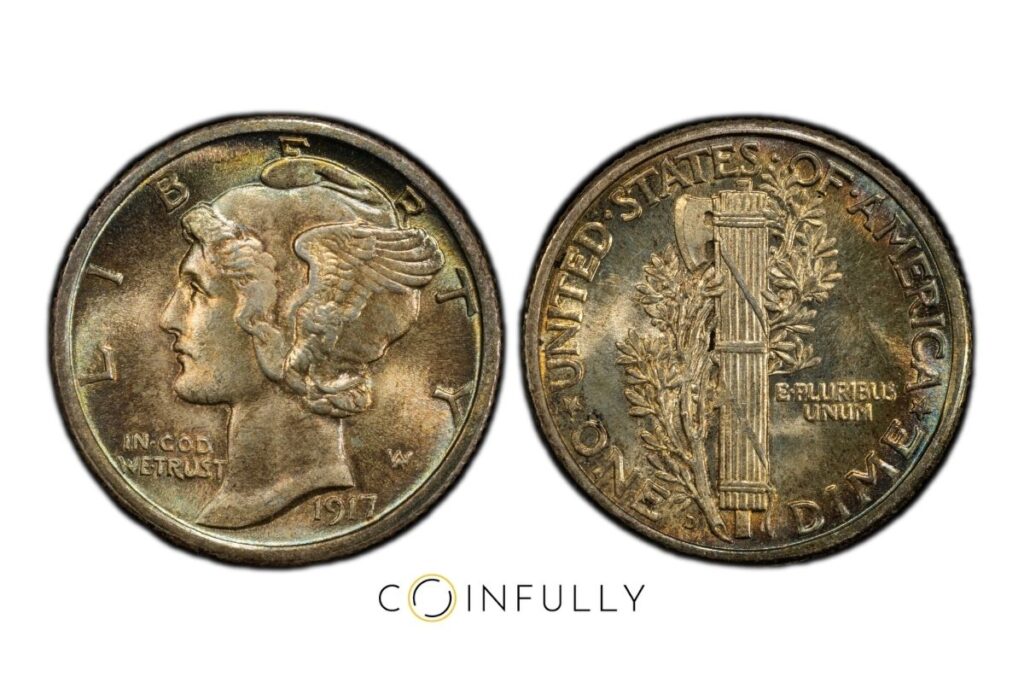
The Mercury dime was designed by Adolph A. Weinman, the same man who designed the Walking Liberty half dollar, and was produced from 1916–1945 (though none were struck in 1922, 1932, or 1933). It replaced the Barber dime and signaled a departure from rigid, utilitarian imagery.
Although commonly associated with the Roman god Mercury, the figure actually represents Lady Liberty, with wings symbolizing freedom of thought. This misunderstanding led to the enduring nickname that still defines the series today.
Coin Obverse
The obverse depicts Liberty facing left, wearing a winged Phrygian cap that led many to associate the design with the Roman god Mercury. Weinman’s initials appear to the right of Liberty’s neck near the truncation, while the date is positioned prominently at the lower rim.
Coin Reverse
The reverse features a fasces, an ancient Roman symbol of unity and authority, paired with an olive branch to represent peace. The vertical fasces is wrapped with horizontal bands, a critical area for collectors assessing strike quality.
How Much Are Mercury Dimes Worth? Influencing Factors
Mercury dimes’ value ranges from a few dollars for a worn common date to five figures for a scarce issue in gem condition with Full Bands. Five factors account for that spread: condition, rarity, strike quality, date and mintmark, and silver content.
Coin Condition
Condition is often the most important factor influencing Mercury dime values. Coins with minimal wear; strong detail on Liberty’s cheek, hair, and the cap wing; and undisturbed surfaces command far higher prices than heavily circulated examples.
Original luster, clean rims, and sharp lettering are especially important to coin collectors. Pieces preserved in top condition are far scarcer than worn examples, even among common dates, and coins graded by PCGS or NGC are typically worth more than ungraded coins.
Rarity
Rarity reflects how many examples actually survive in collectible condition. Some Mercury dimes were heavily used in circulation, which reduced survival rates for higher-quality pieces.
Others exist in sufficient numbers but are scarce in high-grade examples. Rare Mercury dimes often owe their status to low survival in mint state rather than limited production alone, which significantly increases demand among advanced collectors.
Full Bands
When the central horizontal bands on the fasces are fully separated, the coin may qualify for the Full Bands designation, or FB, by grading services, particularly for Mercury dimes graded MS65 or higher.
Date, Mintmark, and Mintage
The date and mintmark reveal where and when a Mercury dime was produced, which directly affects scarcity and demand.
The series was struck from 1916 to 1945, except for years 1922, 1932, and 1933, at the Philadelphia Mint, Denver Mint, and San Francisco Mint, with each facility producing varying mintages.
Certain issues minted in Denver or San Francisco had significantly lower output, making them more difficult to locate today. A key date Mercury dime with a low original mintage often carries a substantially higher market value, especially when paired with strong preservation.
Silver Content
Each Mercury dime contains 90% silver and 10% copper, which gives it inherent precious metal worth regardless of condition. The intrinsic value of Mercury dimes establishes a base price, but it represents only a small portion of the coin’s overall worth for collectible examples.
How To Determine Mercury Dime Value
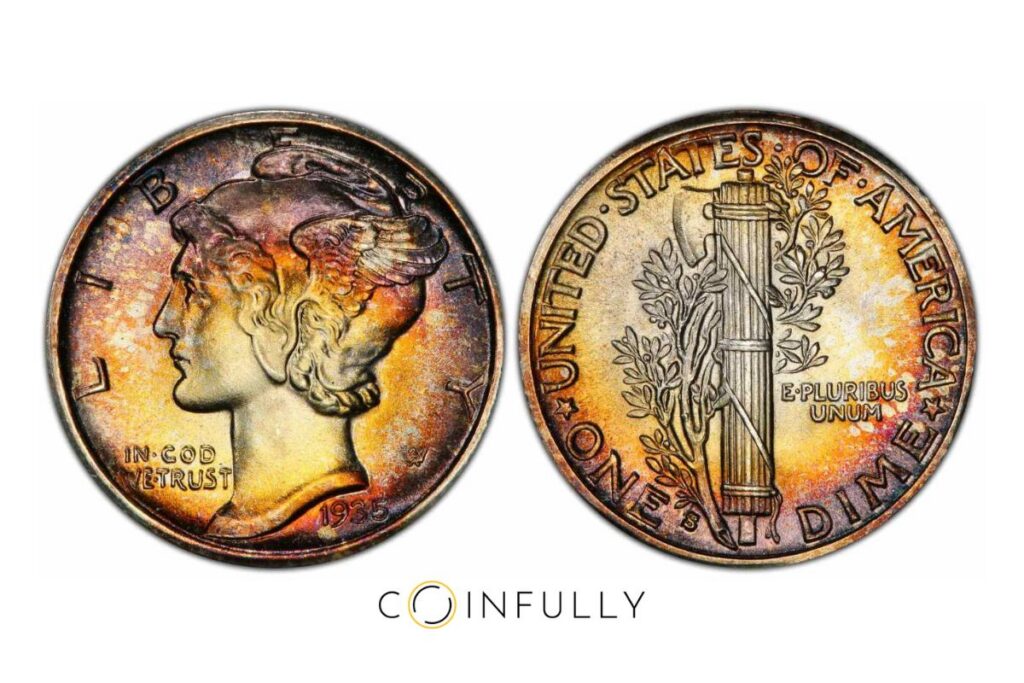
Start by identifying the date and mintmark. Then, closely examine the coin for wear on high points, overall sharpness, and surface quality. Strike strength and originality can greatly influence desirability, especially for pieces that appear lightly circulated.
Professional appraisal and grading provide the most reliable assessment, as they account for condition, authenticity, and market standards.
Because demand fluctuates, accurate valuation also depends on current collector interest and recent verified transactions, making expert review essential before selling.
Once you’ve learned your coin’s value, knowing where to sell Mercury dimes matters. Research options carefully before committing to a sale.
Other Rare and Valuable U.S. Dimes
While Mercury dimes are among the most collected silver dimes, several earlier and later U.S. dime series contain issues that are equally important to American numismatic history.
- Draped Bust Dimes: Designed by Robert Scot and struck from 1796 to 1807, Draped Bust dimes represent the first silver dimes issued by the United States. They feature a draped bust of Liberty on the obverse and a small eagle or heraldic eagle on the reverse, depending on the year. Key dates include 1804, 1796, and 1797 issues.
- Capped Bust Dimes: These were produced from 1809–1837, designed by John Reich, and later modified by William Kneass. The obverse shows Liberty wearing a cap. The reverse features an eagle with a shield. Some varieties, such as the 1828 Capped Bust dime, and early issues are difficult to locate in higher grades.
- Seated Liberty Dimes: Minted from 1837 to 1891, Seated Liberty dimes depict Liberty seated on a rock holding a shield and pole. Christian Gobrecht’s design evolved over decades, with changes in stars, arrows, and legends. Notable key dates include the 1871-CC and 1873-CC.
- Barber Dimes: Designed by Charles E. Barber, these were struck from 1892 to 1916. The obverse features a classical portrait of Lady Liberty, while the reverse displays a wreath surrounding the denomination. Several early San Francisco and New Orleans issues from the 1890s, particularly the 1894-S, are considered key dates.
- Roosevelt Dimes: These were introduced in 1946 to honor President Franklin D. Roosevelt and remain in production today. Early silver issues from the late 1940s and 1950s are collectible, especially lower-mintage years and well-preserved examples.
How Coinfully Can Help
Coinfully is a coin-buying service founded by brothers Travis and Wyatt McDonald in Charlotte, North Carolina.
Coinfully offers a free online coin appraisal that lets you discover what your Mercury dimes or other coins may be worth without any pressure to sell.
You provide clear photos or an inventory of your coins, and a numismatic expert from Coinfully will deliver a detailed appraisal at no cost to you along with a market-driven offer. If you decide to sell, your coins are protected. Coins shipped to Coinfully are insured by Lloyd’s of London.
For qualifying larger or historically important collections, Coinfully offers a white-glove at‑home coin appraisal service. A qualified expert will travel to your location to assess your coins in person, answer your questions, and make an offer that you’re free to accept or decline.
“Coinfully gives a seller an opportunity to get a fair offer that wouldn’t be available to 90-plus percent of prospective sellers.” – Douglas Winter, Chief Numismatic Advisor
Douglas Winter, the American Numismatic Association’s 2024 Numismatist of the Year and author of the standard references on U.S. branch-mint gold, is the Chief Numismatic Advisor at Coinfully.
Whether you want to sell coins online or in person, getting a professional appraisal from Coinfully gives you confidence in your collection’s documented value and positions you to make informed decisions about selling, insuring, or preserving your coins for the future.
*Coinfully is an accredited member of the American Numismatic Association, an authorized, registered dealer with both PCGS and NGC, and BBB accredited with an A+ rating.
Frequently Asked Questions About Valuable Mercury Dimes
Are mercury dimes valuable?
All Mercury dimes contain 90% silver, so even worn common dates carry a few dollars in metal value. Scarce dates, the two 1942 overdates, and gem examples with Full Bands reach well into the thousands, and the 1916-D exceeds $50,000 in top condition.
How much is a mercury dime worth?
Value depends on date, mintmark, condition, and strike. Common dates from 1934 through 1945 trade near silver in circulated grades. Earlier issues, low-mintage dates, and coins with fully separated central horizontal bands on the reverse command substantially more.
What mercury dimes are worth money?
The 1916-D, both 1942 overdates, the 1921 and 1921-D, and the 1926-S carry premiums even when worn. The 1918-D, 1919-D, 1919-S, 1923-S, and 1945 are common in circulation but reach four and five figures in gem grades with Full Bands.
What is the most valuable Mercury dime?
The 1916-D, with a mintage of 264,000, is the series key and the most valuable of the rarest Mercury dimes across all grades. NGC lists it at $1,700 in Good and $52,500 in MS65 with Full Bands, which is higher than any other date at comparable levels of preservation.
What is the most expensive mercury dime?
Single-coin auction records belong to condition rarities rather than key dates. In 2019, a 1938-S graded MS68+ Full Bands sold for $364,250, and a 1931-S in MS67+ Full Bands brought $270,250. Both are common dates in circulated grades.

