

Learn which blue-seal notes are genuinely rare, what common ones sell for, and how to tell what you have.
The 10 most valuable silver certificates available to collectors are:
- 1896 $5 Educational
- 1880 $20 “Stephen Decatur”
- 1880 $10 “Robert Morris”
- 1886 $5 “Silver Dollar Back”
- 1891 $20 “Daniel Manning”
- 1896 $2 Educational
- 1899 $5 “Chief”
- 1933 $10 Silver Certificate
- 1923 $5 “Porthole”
- 1886 $1 “Martha Washington”
Silver certificates circulated in the United States from 1878 to 1964, and each one could be exchanged at a bank for its face value in silver. Redemption ended in 1968.
Most surviving examples sell for a few dollars over face value, but a small number bring five and six figures. Series, denomination, and condition determine into which category a note falls.
If you own valuable silver certificates, an appraisal will verify what they’re worth in today’s market. Coinfully offers free online appraisals that can be completed from home and can be used for selling, estate, and insurance purposes.
Table of Contents
What Silver Certificates Are Worth Money?
Most silver certificates are worth a few dollars. The 1935 and 1957 $1 notes were printed in the billions and typically sell for roughly $1.50 to $4 in circulated grades.
Large-size silver certificates issued between 1878 and 1923 carry the highest values, particularly denominations of $5 and above. Among small-size notes, the 1933 $10 and 1928 series varieties command the strongest prices.
Star notes, low or fancy serial numbers, and printing errors add value across every series. Condition governs everything, and an uncirculated note can be worth many times its circulated equivalent.
10 Most Valuable Silver Certificates for Collectors
Every note on this list has changed hands at public auction in recent years. None sits permanently in a museum, and each can be bought by a collector willing to meet the price.
1896 $5 Educational
Walter Shirlaw designed the allegorical scene of Electricity presenting light to the world, and George F. C. Smillie and Charles Schlecht engraved it. Grant and Sheridan appear on the reverse. Bare-breasted figures drew objections from banks, and the series was withdrawn within two years.
Circulated examples can bring four figures, uncirculated notes five figures, and finest-known examples reach six figures.
1880 $20 “Stephen Decatur”
Stephen Decatur, the naval officer who commanded at Tripoli, appears at right against a dense engraved background.
Several seal and signature combinations exist, all scarce, with the surviving population believed to fall well under 100 notes. Circulated examples bring five figures, and uncirculated survivors climb toward six.
1880 $10 “Robert Morris”
Robert Morris, who financed the Continental Army, appears at left. Seal color and signature combination separate the varieties, and scarcity differs sharply among them. Circulated examples bring mid-four to low-five figures, with uncirculated notes well into five figures.
1886 $5 “Silver Dollar Back”
Ulysses S. Grant appears at left. The reverse shows five 1886 Morgan silver dollars in a row with both faces of the coin represented, making this the only U.S. note built around a coin design.
Seven varieties exist and values swing widely between them, from low-four figures circulated to high-five uncirculated.
1891 $20 “Daniel Manning”
Daniel Manning, Grover Cleveland’s Treasury Secretary, appears at center between allegorical figures. The reverse was redesigned with more open space than the 1886 issue, which was a change intended to make alterations easier to detect.
Circulated examples bring four figures, and uncirculated notes reach five.
1896 $2 Educational
Edwin Blashfield designed the face, showing Science seated between Steam and Electricity as they present their gifts to Commerce and Manufacture. Robert Fulton and Samuel Morse appear on the reverse.
Circulated examples bring low-four figures, uncirculated notes often see five figures, and gem examples can be considerably more.
1899 $5 “Chief”
Chief Running Antelope, a Hunkpapa Lakota leader, appears at center wearing a Pawnee headdress. His own regalia stood too tall for the engraving frame, so the Bureau substituted the headdress of a rival nation.
This is the only U.S. note with a Native American as the central portrait. Values range from the upper hundreds circulated to five figures uncirculated.
1933 $10 Silver Certificate
Issued after the Emergency Banking Act, this note promises payment in silver rather than silver dollars, which marked the shift away from coin redemption.
Of 216,000 printed, only a fraction reached circulation. Circulated examples bring mid-four figures and uncirculated notes five. The 1933A survives in single-digit numbers and trades far higher.
1923 $5 “Porthole”
Lincoln appears inside a circular frame that gives the note its nickname, and the Great Seal fills the reverse.
A single Friedberg variety exists that carries Speelman and White signatures, with roughly 5,000 believed to survive. Circulated examples bring four figures, and uncirculated notes reach five.
1886 $1 “Martha Washington”
Martha Washington is featured as the portrait and is the first real woman to do so on U.S. paper currency. Four seal and signature varieties exist, and their scarcity differs. Circulated examples bring high hundreds, with uncirculated notes reaching five figures.
Other Valuable Silver Certificates Worth Money
The 10 notes above represent the upper tier, but the following issues sit just below it, and several are considerably easier to find.
- 1896 $1 Educational: This is the most affordable entry into the Educational series, showing History instructing Youth before the Capitol. It’s worth low hundreds circulated and five figures for gem examples.
- 1886 $10 “Tombstone”: Thomas Hendricks, the only vice president who never became president to have his portrait featured on U.S. paper currency, sits inside an ornate frame that resembles a headstone. It’s worth low thousands circulated and five figures uncirculated.
- 1891 $10: This note has the same portrait as the 1886 $10 note but with a redesigned reverse. It’s more available than the 1886 note, bringing low thousands in circulated condition and five figures in uncirculated condition.
- 1891 $1 “Martha Washington”: This marks the second appearance of Martha Washington on U.S. currency. It’s worth low hundreds circulated and five figures at the top of the grading scale.
- 1928E $1 “Funnyback”: Roughly 3.5 million were printed compared to hundreds of millions for common varieties in the series. It’s worth low hundreds circulated and low thousands uncirculated. Star notes multiply both.
- 1935A $1 Experimental “R” and “S”: A 1944 paper test marked regular stock with a red R and experimental stock with a red S. These are worth low hundreds circulated and low thousands uncirculated, with matched pairs bringing a premium.
Wartime Emergency Issues
- 1935A $1 Hawaii: Brown seals and HAWAII overprints identified currency that could be demonetized if the islands fell to Japan. It’s worth low hundreds circulated, and star notes can reach five figures.
- 1935A $1 North Africa: A yellow seal marked currency issued to troops in the North African and European campaigns. They’re typically worth low hundreds circulated, with star notes considerably higher.
Common Silver Certificates Often Found in Inherited Coin Collections
These are the notes that you’ll most likely encounter in an inherited collection. Billions were printed across the small-size $1 series alone, and most examples are worth a few dollars regardless of how worn they are.
- 1957, 1957A, and 1957B $1: These are the final $1 silver certificates ever issued and the most common by a wide margin. Circulated examples bring a few dollars over face value, and crisp uncirculated notes reach low double digits.
- 1935 $1 and letter varieties A through H: This series accounts for the bulk of surviving notes. Circulated examples bring a few dollars, while uncirculated notes reach low double digits depending on the letter.
- 1934 $5 and 1934 $10: Blue seals on the familiar small-size format make these easy to mistake for something scarce. Circulated examples bring roughly $10–$15, with the $10 note running higher than the $5.
- 1953, 1953A, and 1953B $5: These were the last $5 silver certificates produced. Circulated notes bring less than $15, and uncirculated examples reach double digits.
- 1923 $1 “Horse Blanket”: The oversized format and 1923 date suggest rarity, but roughly a million survive. Circulated examples bring less than $20, and uncirculated notes reach low hundreds.
- 1899 $1 “Black Eagle”: The eagle design is among the most recognized in American currency, and the note is common despite its age. Circulated examples bring prices in the upper teens to low hundreds, with uncirculated notes several times that.
Check every note in this group for a star beside the serial number, an unusual serial pattern, or a printing error. Any of those three can move a common note into a materially different price range.
How To Identify What You Own
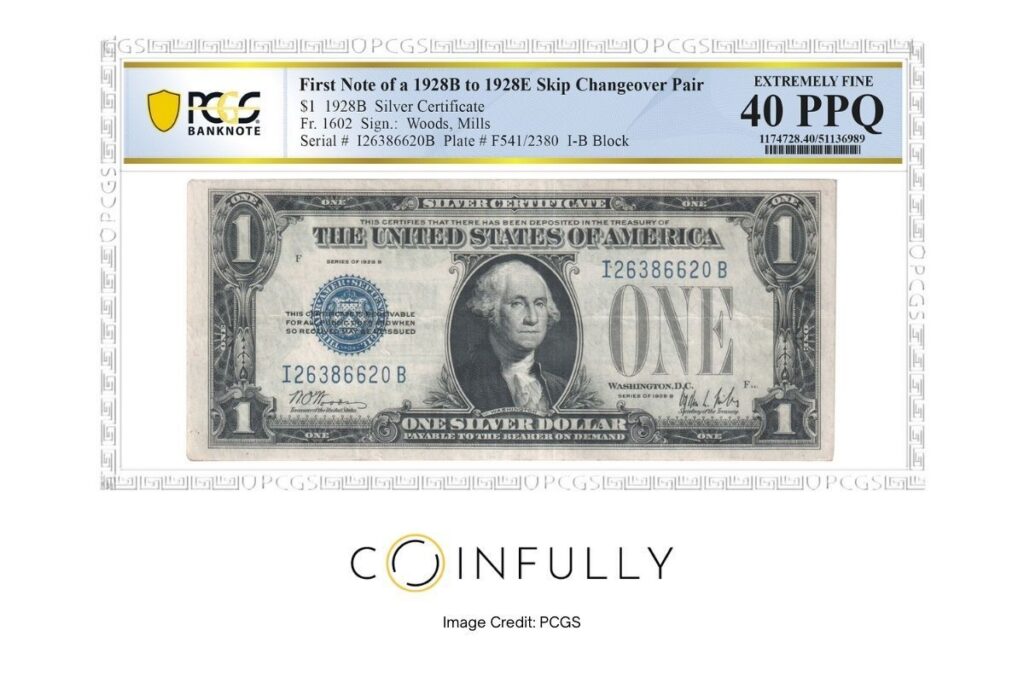
The blue Treasury seal and the words SILVER CERTIFICATE across the face identify the note. Anything printed before 1928 measures roughly 7.4 by 3.1 inches, which collectors call a horse blanket. Small-size notes match modern currency dimensions.
The 1928 and 1934 $1 issues carry a large ornamental ONE on the reverse and are known as funnybacks. Brown seals mark Hawaii notes, and yellow seals mark North Africa issues.
What Actually Moves Value
Two notes of the same series and denomination can differ in price by a large factor. Six variables account for nearly all of the value differences.
- Grade: Folds, soiling, and pinholes separate a $5 note from a $500 one.
- Star notes: A star replaces the suffix letter on replacement notes, which were printed in far smaller quantities.
- Series letter: The letter following the date marks a signature change, and scarcity varies sharply between them.
- Signature combination: Large-size notes carry multiple Friedberg varieties tied to Treasury officials.
- Serial numbers: Low, repeating, and solid numbers draw premiums.
- Errors: Misalignments, inverted overprints, and mismatched serials command strong prices.
Beware of Counterfeits and Doctored Currency
Altered genuine notes are more common than outright counterfeits. Washing, pressing, and repairing tears can lift a note several grades on visual inspection while destroying its value to a grader. Added stars and modified serial numbers also appear.
Third-party grading through PMG or PCGS Banknote settles both questions permanently.
History of U.S. Silver Certificates
The Bland-Allison Act of 1878 required the Treasury to purchase silver and strike it into dollars, and silver certificates followed as a practical solution to the physical problem of carrying heavy coins.
Silver dollars were heavy and unpopular in commerce, so the certificates let the public hold paper that was redeemable for coins sitting in Treasury vaults.
The Sherman Silver Purchase Act of 1890 expanded those purchases and prompted the Series 1891 redesign, though Congress repealed it three years later during the Panic of 1893.
Note dimensions shrank in 1928, ending the large-size era. The Silver Purchase Act of 1934 shifted redemption from coin to bullion, and Series 1934 notes carry revised wording reflecting that change.
Rising silver prices in the early 1960s made redemption untenable, and President Kennedy authorized Federal Reserve Notes to replace the $1 denomination in 1963. Congress ended silver redemption entirely on June 24, 1968.
10 Most Valuable Silver Certificates of All Time
Four portraits account for every note on this list: Edward Everett on the $50, James Monroe on the $100, Charles Sumner on the $500, and William Marcy on the $1,000.
Most have never sold publicly, so the ordering below reflects rarity and denomination rather than confirmed sale prices.
- 1891 $1,000 “Marcy”: Two examples are known, one of which is held by the Smithsonian. The privately owned note sold for $2.6 million in 2013.
- 1878 $1,000 “Marcy”: This is the first $1,000 silver certificate, surviving almost entirely in institutional collections.
- 1880 $1,000 “Marcy”: There are a handful of examples across several signature varieties.
- 1878 $500 “Sumner”: This is the scarcest of the $500 issues.
- 1880 $500 “Sumner”: One example resides at the Federal Reserve Bank of San Francisco.
- 1891 $500 “Sumner”: This is the most attainable $500 silver certificate, but only a handful are thought to survive.
- 1878 $100 “Monroe”: These are triple-signature notes that rank among the great rarities.
- 1880 $100 “Monroe”: You’ll see these occasionally offered, always at six or seven figures.
- 1878 $50 “Everett”: This is the entry point to this tier and still exceptionally rare.
- 1880 $50 “Everett”: Several varieties exist, and each is scarce.
What To Do if You Own Rare Silver Certificates
If you have a valuable silver certificate, don’t clean, press, flatten, or attempt to repair the note. Every intervention is detectable under magnification and permanently reduces value. Handle it by the edges, and never use tape, glue, staples, or paper clips.
Store the note flat in an archival Mylar currency sleeve, away from light, heat, and humidity. Do not fold along existing creases to fit a holder.
Have the note appraised before deciding whether third-party grading makes sense and when considering whether or not to sell your paper currency.
Where To Get Valuable Silver Certificates Appraised
- Local coin shops offer in-person evaluation and immediate offers.
- Online appraisal services review submitted photographs and provide written valuations remotely.
- Major auction houses evaluate consignments and handle high-denomination notes regularly.
- Professional numismatists certified by the ANA or PNG perform formal appraisals for insurance, estate, and selling purposes.
- Third-party grading through PMG or PCGS Banknote authenticates and assigns a numerical grade, though grading differs from appraising and should be reserved for particularly valuable notes.
How Coinfully Can Help
Coinfully is a Charlotte-based online coin company founded by brothers Travis and Wyatt McDonald. Coinfully appraises and buys rare coins and currency.
“Coinfully gives a seller an opportunity to get a fair offer that wouldn’t be available to 90-plus percent of prospective sellers.” – Douglas Winter, Chief Numismatic Advisor
Douglas Winter, the American Numismatic Association’s 2024 Numismatist of the Year and author of the standard references on U.S. branch-mint gold, is the Chief Numismatic Advisor at Coinfully.
For qualifying large or historically important collections, Coinfully will send a numismatist to your home for an in-person appraisal.
Coinfully also provides professional appraisals online at no cost and simplifies the process of selling coins and currency remotely. All currency shipped to Coinfully is fully insured by Lloyd’s of London, and packages are opened under 4K security cameras.
*Coinfully is an accredited member of the American Numismatic Association, an authorized, registered dealer with both PCGS and NGC, and BBB accredited with an A+ rating.
Frequently Asked Questions About Valuable Silver Certificates
Are silver certificate dollars worth anything?
Yes, silver certificates hold value, though most are worth only a few dollars. The 1935 and 1957 $1 notes were printed in the billions and bring $1.50 to $4 circulated. Older large-size notes, star notes, and error notes carry substantially higher premiums, and condition affects every valuation.
What is a silver certificate worth today?
Values range from roughly $1.50 for a circulated 1957 $1 to six figures for high-grade Educational Series notes. Series, denomination, and condition determine the figure. Large-size notes issued between 1878 and 1923 consistently outperform the small-size issues printed after 1928.
What silver certificate dollars are worth money?
Among $1 notes, the 1886 and 1891 Martha Washington issues, the 1896 Educational, and the 1899 Black Eagle carry the highest values. The 1928E funnyback, 1935A experimental R and S notes, and Hawaii and North Africa emergency issues also bring strong premiums.
What is the rarest silver certificate?
The 1891 $1,000 Marcy is the rarest silver certificate, with two known examples. One belongs to the Smithsonian and the other sold privately for $2.6 million in 2013. Several 1878 and 1880 high-denomination notes survive in comparably small numbers and are mostly held in institutional collections.
Can you still cash in silver certificates?
No, you can no longer cash in silver certificates. Congress ended silver redemption on June 24, 1968, and the Treasury no longer exchanges these notes for silver or bullion. They remain legal tender at face value, meaning a $1 silver certificate spends as one dollar, which is far below what collectors pay for most examples.
Are silver certificates a good investment?
The answer depends on what you buy and what you pay. Values reflect rarity, condition, and collector demand rather than silver content, since redemption ended in 1968. Third-party graded notes from scarce series have established auction records you can research before purchasing.

