Walking Liberty Half Dollar (1916–1947): Coin Value Guide
How Much Are Walking Liberty Half Dollars Worth?

Mar 5th, 2026 · 5 Minute Read
The following Walking Liberty half dollars are considered the most valuable in the series, with values reflecting top-condition examples and record-setting auction results achieved by elite, professionally graded coins.
- 1921-S Walking Liberty Half Dollar: $105,000
- 1921-D Walking Liberty Half Dollar: $40,000
- 1919-S Walking Liberty Half Dollar: $25,000
- 1917-S Walking Liberty Half Dollar: $22,000
- 1918-D Walking Liberty Half Dollar: $22,000
- 1919-D Walking Liberty Half Dollar: $18,500
- 1920-D Walking Liberty Half Dollar: $17,500
- 1921 Walking Liberty Half Dollar: $17,500
- 1920-S Walking Liberty Half Dollar: $15,000
- 1918-S Walking Liberty Half Dollar: $14,250
The most valuable Walking Liberty half dollars are typically key dates and low-mintage issues, such as the 1921-S, 1921-D, and select 1917–1921 coins, particularly in high-grade, well-preserved condition.
Rarity, survival rate, and collector demand drive premiums far above intrinsic silver value, making coins with limited circulation or exceptional strike quality the most sought after by serious numismatists.
The Walking Liberty half dollar is one of the most celebrated coins in U.S. history, admired for its elegant artistry and rich historical significance.
Minted from 1916 until 1947, these silver coins captured the spirit of a nation through times of prosperity, war, and economic challenge. Collectors prize them not only for their intrinsic silver content but also for their rarity, design, and historical value.
Whether you are a seasoned numismatist, exploring the market for the first time, or thinking of selling, understanding the most valuable issues, key dates, and factors that influence value is essential to making informed decisions about your collection.
When you’re ready to sell Walking Liberty half dollars in your collection, Coinfully makes it easy with free online coin appraisals, top-market offers, and fast, secure payments.
Overview of Walking Liberty Half Dollars
The Walking Liberty half dollar is widely regarded as one of the most iconic coins in U.S. coinage and is prized by collectors for its artistic beauty, historical significance, and scarcity in high grades.
While millions of these silver coins circulated between 1916 and 1947, only a small number of issues command exceptional premiums today. These are often defined by low mintage numbers, challenging production years, and survival rates.
Fun Fact: In November of 2004, a Walking Liberty silver half dollar minted at the Denver mint in 1919 sold for $270,250.
The Walking Liberty designs are not the only silver half dollars worth serious money. There are several other valuable silver half dollars, such as Franklin half dollars and Barber half dollars, to watch for.
A Closer Look at the Most Valuable Liberty Half Dollars
Certain Walking Liberty half dollars stand apart due to extremely low survival rates, poor strike quality, or limited mintages during difficult production years.
While common circulated examples hold significant silver value, pristine, uncirculated versions can command thousands of dollars due to their beautiful design and collector demand.
This is true whether you are holding a 1945 Walking Liberty half dollar, a 1943 Walking Liberty half dollar, 1942 Walking Liberty half dollar, or another key issue.
Below is a closer examination of the top 10 Liberty Walking half dollars that consistently rank among the most desirable and valuable coins in the series.
1921-S Walking Liberty Half Dollar
Minted in San Francisco during a post-war economic slowdown, the 1921-S Walking Liberty half dollar is widely regarded as the series’ premier key date.
Extremely low mintage combined with weak strikes and heavy circulation make high-grade examples of this rare coin exceptionally scarce and fiercely sought after by advanced collectors.
1921-D Walking Liberty Half Dollar
The 1921-D was struck at the Denver Mint in very limited numbers, resulting in one of the lowest mintages of the entire series.
Most examples entered circulation immediately, and well-preserved specimens are rare, especially those with sharp details on Liberty and full feather definition on the reverse.
1919-S Walking Liberty Half Dollar
Produced at the San Francisco Mint, the 1919-S is notorious for poor strike quality and limited availability in higher grades.
Even lightly worn examples command strong premiums, while mint state coins are exceptionally rare due to production challenges and heavy circulation shortly after release.
1917-S Walking Liberty Half Dollar
The 1917-S is valued for its scarcity in well-struck condition, particularly examples with strong detail throughout the design. Minted during World War I, many coins circulated heavily, leaving few survivors with original luster and crisp design elements intact.
1918-D Walking Liberty Half Dollar
Struck in Denver during wartime production, the 1918-D Walking Liberty half dollar is difficult to locate in high grades due to widespread circulation and typically weak strikes. Collectors prize examples with strong definition on Liberty’s gown and a clearly detailed reverse.
1919-D Walking Liberty Half Dollar
The 1919-D stands out as one of the toughest Denver issues in the series to find.
Limited production and heavy circulation sharply reduced the number of high-grade survivors, making well-preserved examples especially valuable to collectors seeking to complete high-quality Walking Liberty sets.
1920-D Walking Liberty Half Dollar
Minted in Denver during a period of declining half dollar production, the 1920-D is scarce in mint state due to extensive circulation. Coins with full detail and minimal wear are difficult to locate, which contributes to its steady demand and strong market performance.
1921 Walking Liberty Half Dollar
Produced at the Philadelphia Mint, the 1921 Walking Liberty half dollar is notable for its low mintage and poor strike quality. Many examples exhibit soft details, making sharply struck coins rare and highly desirable among collectors assembling premium-grade sets.
1920-S Walking Liberty Half Dollar
The 1920-S is another San Francisco issue known for weak strikes and limited availability in higher grades. While circulated examples are obtainable, coins with original luster and strong detail are scarce, so well-preserved specimens drive significant premiums.
1918-S Walking Liberty Half Dollar
Minted during World War I, the 1918-S Walking Liberty half dollar saw heavy circulation almost immediately after release.
Heavy circulation combined with typically weak strikes from the San Francisco Mint resulted in a limited number of high-grade survivors, particularly those with strong reverse detail.
What Determines Walking Liberty Half Dollar Value?
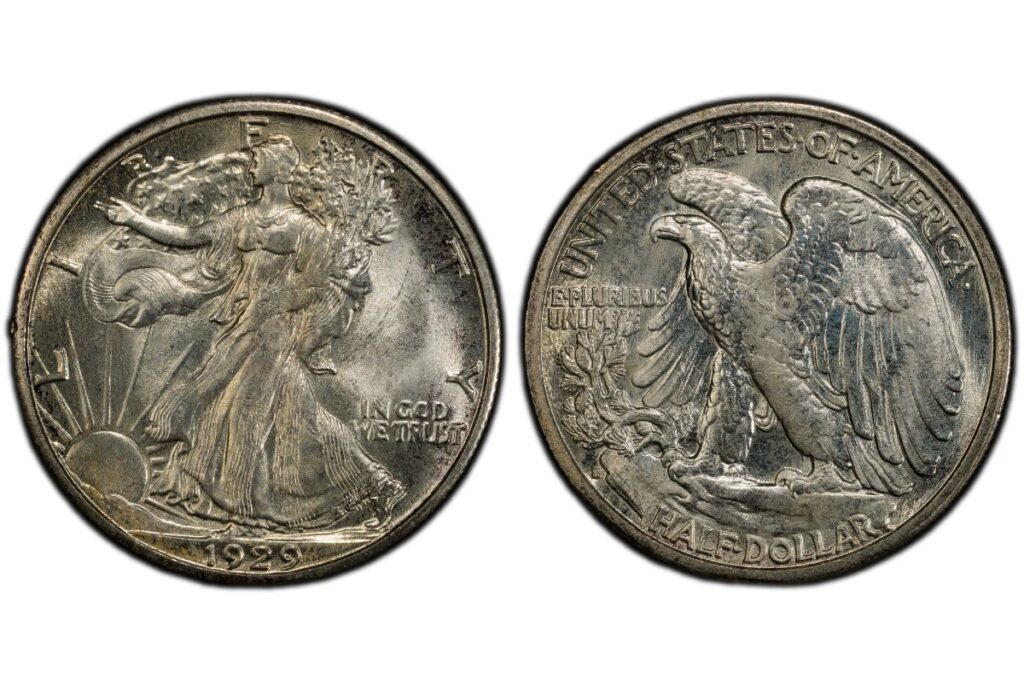
Walking Liberty half dollar coin value is shaped by a combination of historical significance, physical preservation, and market demand within the numismatic community.
While all examples contain silver, subtle differences in date, mintmark, condition, and rarity can result in dramatic price variations between individual coins.
When learning how to sell silver coins, understanding the specific factors that determine value is essential to ensure you receive a fair selling price.
Walking Liberty Half Dollar Mint Mark and Coin Date
Date and mintmark can greatly impact value, as production varied significantly by year and location. Coins were struck at Philadelphia, Denver, and San Francisco, with many issues from Denver and San Francisco produced in far lower quantities.
Certain combinations are considered key dates, commanding substantial premiums due to scarcity and collector demand.
Coin Condition
Condition reflects how much a coin has worn from circulation and handling over time. Coins that circulated heavily often show flattened design details, surface marks, or diminished luster.
In contrast, examples that avoided extended circulation retain sharper features and cleaner surfaces, making them significantly more desirable to collectors seeking higher-quality pieces.
Grade Assigned by NGC or PCGS
A coin’s assigned grade from a professional coin grading service such as NGC or PCGS provides an objective assessment of authenticity and condition.
Certified coins offer greater market confidence and liquidity, with small differences in grade often translating into large swings in value, particularly for scarce or high-demand dates.
Silver Content
Each Walking Liberty half dollar contains 90% silver and 10% copper, giving it a net silver weight of approximately 0.3617 troy ounces per coin. This composition gives each coin an inherent baseline value tied to silver bullion prices.
However, melt value alone rarely reflects a coin’s true worth, as numismatic premiums frequently far exceed silver content, especially for scarce dates or coins in superior condition.
Rarity
Rarity considers not only how many coins were originally produced but how many survive today in collectible condition. Many issues were widely circulated or melted, leaving limited high-grade examples.
Coins with low surviving populations consistently attract strong demand, making rarity one of the most powerful drivers of long-term value.
History of the Liberty Half Dollar (1916–1947)
The Walking Liberty half dollar was minted from 1916 to 1947, introduced as part of a broader effort to modernize U.S. coinage after the Barber coins series.
This coin was designed by Adolph A. Weinman, the sculptor and designer of the Mercury dime and a student of Augustus Saint-Gaudens, the famous designer of the $20 Double Eagle and $20 Double Eagle Gold coins.
He created the design to symbolize national strength and optimism, featuring Lady Liberty striding toward the sunrise.
This popular US coin was minted at the Philadelphia, Denver, and San Francisco Mints, and the coin circulated widely during World War I, the Roaring Twenties, the Great Depression, and World War II.
Its issuance ended in 1947 when it was replaced by the Franklin half dollar, but the series remains highly revered among numismatic collectors for its artistry, historical significance, and role in U.S. monetary history.
Liberty Walking Half Dollar Coin Design

The Walking Liberty half dollar’s design is widely regarded as one of the most beautiful in U.S. coinage history, combining artistic elegance with symbolic imagery that reflects national pride.
Struck from 1916 until 1947, the coin, sometimes mistakenly referred to as a Standing Liberty half dollar, showcases an image of Lady Liberty in motion and a striking bald eagle on the reverse, making it a favorite among collectors and investors alike.
The Lady Liberty design was so popular that it was revived for the American Silver Eagle bullion coin introduced in 1986.
Obverse
The obverse Liberty Walking half dollar design features a depiction of Lady Liberty on the obverse, draped in flowing robes and an American flag while striding toward the rising sun, carrying branches of laurel and oak that symbolize civil and military glory.
Weinman’s detailed depiction captures a sense of movement and purpose, while the motto “In God We Trust” appears prominently. Mintmarks are subtly placed on the obverse near the date for coins from Denver and San Francisco. Coins minted in Philadelphia have no mintmark.
Reverse
The reverse portrays a bald eagle perched on a mountain pine with wings partially extended, conveying strength and vigilance. Surrounding the eagle are branches of laurel and oak, representing honor and victory, with coin features carefully designed for balance and clarity.
The inscriptions include “United States of America,” “Half Dollar,” and E Pluribus Unum, emphasizing both artistry and national identity.
Interested in Knowing the Value of Walking Liberty Half Dollars in Your Collection?
Determining the value of your Walking Liberty half dollars requires careful evaluation, ideally by a professional. Relying on generic online price guides can be misleading, set unrealistic expectations, or provide outdated information.
Start by visually inspecting each coin, noting its date, mintmark, and overall condition, but avoid cleaning or polishing, as this can reduce its value. Research recent auction results, and consult reputable references to understand market trends.
For an accurate assessment, it’s best to have your coins professionally appraised by a trusted numismatic expert.
This approach ensures you understand both the silver content and collector premium, helping you make informed decisions about selling, trading, or holding coins while avoiding common pitfalls that can impact their market value.
Should you decide to sell, be sure you understand where to sell silver coins, as not all venues provide fair offers and transparent sales.
Get a Free Coin Appraisal From Coinfully
Accurately assessing the value of your coin collection is critical for maximizing its worth. Coinfully provides professional, transparent appraisals from experienced numismatic experts, ensuring each coin is authenticated, evaluated, and fairly priced.
Whether you are a seasoned collector or new to selling silver coins, a thorough and honest appraisal is the first step toward making informed decisions about your coins.
Free Online Coin Appraisals
Coinfully’s free online appraisal allows you to receive a detailed evaluation from the comfort of your home. Simply provide photos or an inventory of your coins, and our experts will verify authenticity and estimate value based on current market conditions.
This process is designed to be efficient, accurate, and completely transparent in order to give you confidence before making any decisions about selling.
Complimentary At-Home Appraisal Service
For large or historically significant collections, Coinfully offers a complimentary at-home coin appraisal, a service you won’t find offered anywhere else.
A numismatic expert will visit your residence to examine each coin firsthand, provide a professional evaluation, and make a top-of-market offer on the spot.
This personalized service ensures convenience, security, and the highest possible return while allowing you to stay in control throughout the entire process.
Deciding Whether To Keep or Sell Your Walking Liberty Silver Half Dollar Coins
Deciding whether to keep or sell your Walking Liberty half dollars depends on both personal goals and market conditions. If the coins hold sentimental value or complete a long-term collection, retaining them may be the best choice.
However, if you are looking to capitalize on high collector demand, favorable silver prices, or key-date rarities, selling may be advantageous. Consider factors such as condition, rarity, and professional appraisal values before making a decision.
By carefully weighing these aspects, you can make informed choices that balance financial benefit with personal enjoyment. Ultimately, whether you keep or sell, understanding your coins’ true value ensures confidence and satisfaction with your decision.
Thinking about selling your Walking Liberty half dollar or other valuable coins? Contact Coinfully today to discover the true value of your coin collection and receive a market-leading offer.
Wyatt McDonald President & Co-Founder of Coinfully. A student of numismatics and trained in the ANA Seminar in Denver, Wyatt is the face of Coinfully and a true expert. After spending a decade buying coins over the counter at a coin shop, he knew there had to be a better way, for everyone involved.
Get an Appraisal
Think you’re onto something big with your collection? Let’s talk…


 401 Hawthorne Ln, Ste 110-323 - Charlotte, NC 28204